
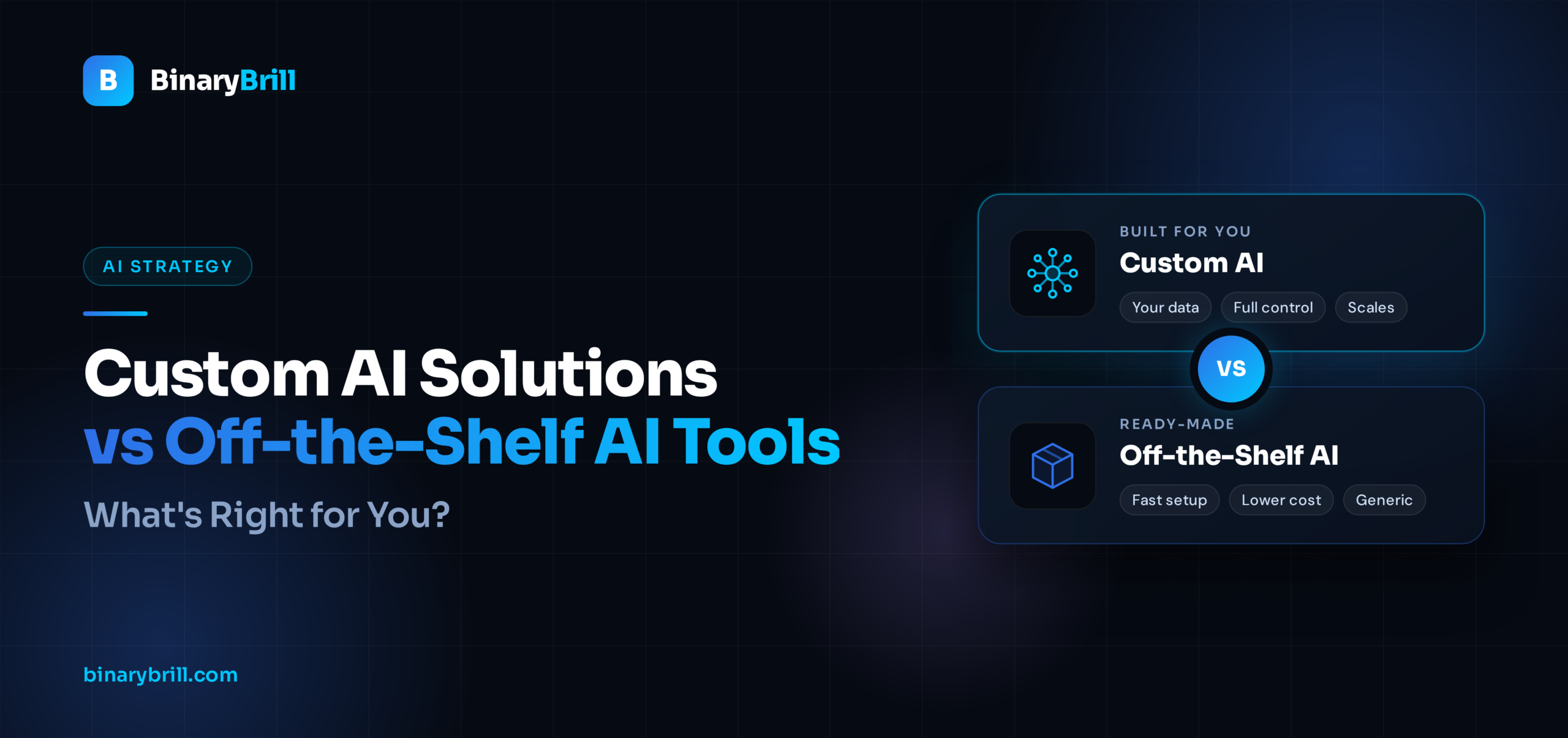
If you’ve spent any time researching AI for your business lately, you’ve probably noticed the same fork in the road keeps showing up: buy something off the shelf, or build something of your own. Both paths get pitched as the obvious answer, which is exactly why so many business owners get stuck.
The truth is less dramatic than either camp likes to admit. Off-the-shelf AI tools solve real problems quickly. Custom AI solutions can do things a pre-built platform never will. Neither is automatically the smarter move; it depends on what you’re trying to fix and what you’re willing to invest.
This guide breaks down custom AI solutions for business and off-the-shelf AI tools side by side, so you can decide based on your actual situation instead of whichever option was pitched to you most recently.
What Are Off-the-Shelf AI Tools?
Off-the-shelf AI tools are ready-made platforms built to solve a common problem for a wide range of businesses. You sign up, connect a few settings, and start using them usually the same day.
You’ve likely already used a few without thinking of them as “AI solutions” at all. Common examples include :
- AI chatbots that handle basic customer questions on a website
- Writing and content tools that help draft emails, blog posts, or product descriptions
- Analytics platforms that surface patterns in sales or website data
- Customer support software with AI-assisted ticket routing or suggested replies
- Automation tools that connect apps and trigger workflows without custom code
These tools are built for the average user, not your specific business broad usefulness in exchange for limited flexibility.
What Are Custom AI Solutions?
Custom AI solutions are built around one business: your data, your workflows, your users, and your existing systems. Instead of adapting your process to fit the software, the software is shaped to fit your process.
A custom AI solution might be trained on your company’s historical data, connected directly to your internal tools, and designed to handle a specific decision your team makes every day, not a generic version of it, but the actual version, edge cases included.
This is where custom AI vs pre-built AI comes down to one question: do you need AI that works in general, or AI that works for you specifically? Custom development trades speed and low upfront cost for precision and control.
Custom AI vs Pre-Built AI : Key Differences
Here’s how the two approaches compare across the factors that matter most when you’re planning a budget and a timeline.
| Factor | Off-the-Shelf AI Tools | Custom AI Solutions |
| Initial cost | Low to moderate, often subscription-based | Higher upfront investment |
| Implementation time | Days to a few weeks | Weeks to several months |
| Customisation | Limited to built-in settings | Fully shaped around your workflows |
| Integration | Restricted to supported apps | Built to connect with your exact systems |
| Scalability | Capped by the vendor’s plan tiers | Built to scale with your business |
| Data ownership | Often shared with or stored by the vendor | Owned and controlled by your business |
| Security | Set by the vendor’s policies | Designed around your specific requirements |
| Maintenance | Handled by the vendor | Your responsibility, or your development partner’s |
| Vendor dependency | High you rely on their roadmap | Low you control the roadmap |
| Long-term flexibility | Limited by the platform’s design | High evolves as your business does |
No row here has a universally “correct” answer. A fast-growing startup might value low initial cost above everything else, while an enterprise handling sensitive customer data might weigh security and data ownership far more heavily.
Benefits of Off-the-Shelf AI Tools
There’s a reason these platforms dominate the market. For a lot of businesses, they genuinely are the right call.
- Faster implementation : Most tools live within days, sometimes hours.
- Lower upfront cost : Subscription pricing spreads the cost out and keeps the entry point low.
- Easier setup : No technical team required for basic configuration.
- Built-in support : Vendors handle updates, bug fixes, and customer service.
- Suitability for standard tasks : If your need is common, drafting marketing copy, summarizing documents, basic chat support someone has already built a good version of it.
For a small business testing a new process, these advantages are hard to argue with.
Limitations of Off-the-Shelf AI Tools
The same design that makes these tools fast to adopt also makes them rigid. Common limitations include :
- Limited customisation : You can adjust settings, but not the underlying logic.
- Integration restrictions : If the tool doesn’t already support your CRM or internal system, you may be out of luck.
- Recurring subscription costs : Monthly fees add up, especially as you add users or usage tiers.
- Vendor lock-in : Your data and workflows become tied to a platform you don’t control.
- Data privacy concerns : Sensitive business or customer data may pass through third-party servers, which can be a problem in regulated industries.
- Feature mismatch : The tool solves the problem it was built for not necessarily the problem you actually have.
Benefits of Custom AI Solutions for Business
Custom AI solutions for business exist to solve the problems off-the-shelf tools can’t. When built well, they offer :
- Workflows designed around the business, not adapted to fit someone else’s template.
- Better use of proprietary data, your own historical records, customer behavior, or operational data become a genuine advantage instead of an untapped resource.
- Custom integrations with the exact systems your team already relies on.
- Greater control over security and permissions, down to who can access what and how data is stored.
- Ability to scale and add features as the business grows, without waiting on a vendor’s product roadmap.
- Potential competitive advantage, since a system built around your specific process isn’t something a competitor can simply subscribe to.
Limitations of Custom AI Development
Custom development isn’t the automatic upgrade it’s sometimes made out to be. It comes with real tradeoffs:
- Higher initial investment, both in cost and internal time.
- Longer development timeline, since the system is being built rather than switched on.
- Need for technical planning, including clear scoping of data, integrations, and success metrics before development starts.
- Ongoing maintenance and model monitoring, since custom AI systems need attention as data and business needs change over time.
When Off-the-Shelf AI Is the Better Choice
A pre-built tool is usually the smarter option when :
- You’re testing an idea and don’t yet know if AI will solve the problem.
- The task is standard content drafting, basic support, and simple analytics.
- Your budget is limited and speed matters more than precision.
- You need something deployed fast, without a development cycle.
- Your data isn’t highly sensitive or heavily regulated.
When a Custom AI Solution Is the Better Choice
A custom build tends to make more sense when :
- Your workflows are unique enough that no existing tool fits them cleanly.
- You’re sitting on proprietary data that a generic tool can’t use effectively.
- You need integrations with internal or legacy systems.
- Your industry has strict security or compliance requirements.
- You’re operating at high volume, where small inefficiencies compound quickly.
- You want AI to become part of your core product, not just an internal helper.
Can Businesses Use a Hybrid Approach?
Yes and for many businesses, this is the most practical path. A hybrid approach means starting with an existing AI API or platform as the underlying engine, then building custom workflows, interfaces, integrations, and data systems around it.
Instead of building an AI model from scratch, a business might use a proven AI API for the core intelligence, while a development team builds the surrounding structure of how data flows in, how results are used, and how it’s presented to users. This gets much of the flexibility of a custom solution without the cost and time of building every layer from zero.
Questions to Ask Before Choosing
Before deciding between custom AI vs pre-built AI, it helps to answer a few honest questions :
- What specific business problem are we trying to solve?
- What’s our realistic budget, including ongoing costs?
- What’s our required launch timeline?
- How sensitive is the data involved?
- What systems does this need to connect with?
- How much usage do we expect, now and in twelve months?
- Do we have internal technical resources to support this?
- Where does AI fit into our long-term plans?
Final Decision Framework
If you want a simple way to think it through, run down this checklist :
- The problem is common and well-defined → lean off-the-shelf
- The problem is specific to how we operate → lean custom
- We need something live in days → lean off-the-shelf
- We can invest weeks or months into getting it right → custom is viable
- Our data is sensitive or regulated → lean custom
- Budget is the primary constraint → lean off-the-shelf, or consider hybrid
- We want AI to be part of our core product → lean custom
- We’re not sure yet → start with off-the-shelf or an API, then evaluate
Conclusion
Neither custom AI solutions nor off-the-shelf AI tools are automatically the better choice. The right answer depends on your business problem, your data, your budget, your timeline, and where you want AI to take your business. Off-the-shelf tools win on speed and simplicity. Custom AI solutions for business win on precision, ownership, and long-term flexibility. Many businesses land somewhere in between, using a hybrid approach to get the best of both.
If you’re weighing custom AI vs pre-built AI for your own business and want a second opinion, Binary Brill can help you think through the options, map out what a build would actually involve, and figure out whether custom, off-the-shelf, or a hybrid setup fits your situation best. Reach out to start the conversation.
FAQs
1. Is a custom AI solution always more expensive than an off-the-shelf tool?
Usually, yes, in terms of upfront cost. But off-the-shelf tools carry ongoing subscription fees that add up over time, so the long-term cost gap can be smaller than it first appears.
2. Can a small business afford custom AI development?
It depends on the scope. A narrowly defined custom solution, or a hybrid approach built on an existing AI API, can be more affordable than a full custom build from scratch.
3. Do off-the-shelf AI tools work for regulated industries?
Sometimes, but data privacy and compliance requirements often push regulated businesses toward custom solutions where they control how and where data is stored.
4. How long does it take to build a custom AI solution?
Timelines vary based on complexity, but most custom AI projects take anywhere from a few weeks to several months, including planning, development, and testing.
5. What’s the easiest way to start if I’m not sure which option I need?
Start with a clear picture of the problem you’re solving, then talk to a development team that can assess whether an off-the-shelf tool, a custom build, or a hybrid approach fits best.
