
Published: October 2, 2026 | Last updated: October 2, 2026
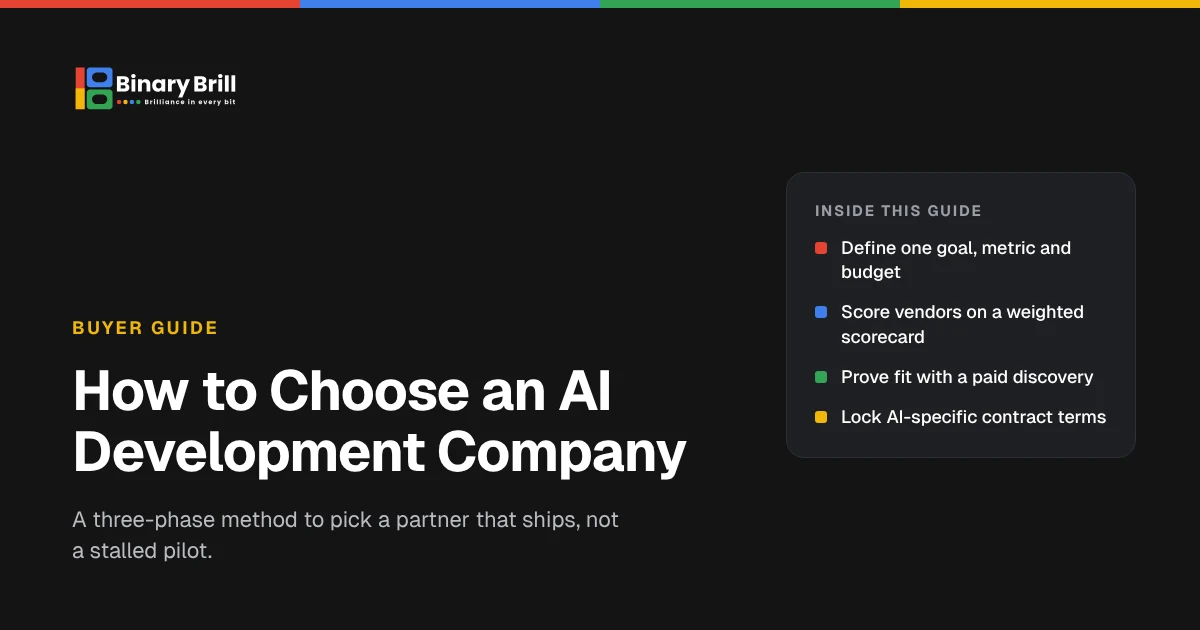
- Define before you shortlist: write one goal with a number, your data sources and a build plus run-cost budget.
- Score vendors on the same scorecard: weight shipped work, scoping quality, engineering depth, IP terms, process and pricing.
- Ask questions only real teams answer: live similar projects, data checks, accuracy testing, monthly run costs and who does the work.
- Prove fit with paid discovery: a short paid engagement fixes scope and price before you commit to the full build.
- Lock AI-specific contract terms: own code, prompts, models and data from day one, with clear acceptance criteria.
- Walk away from red flags: instant fixed prices, guaranteed accuracy, no run-cost estimate or unclear IP ownership.
Are you comparing three AI vendor proposals that look almost identical? Or are you about to sign with the agency that gave the best demo, without being sure it can ship something your team will use every day?
Knowing how to choose an AI development company matters more than it did two years ago. Every software shop now sells AI, and most proposals use the same words: LLMs, agents, RAG, automation. The difference between a partner that ships and one that leaves you with a stalled pilot rarely shows up in a sales deck. It shows up in how they scope, how they handle your data, and what happens after the first demo.
The cost of a wrong pick is real. A bad choice usually means months of spend, a proof of concept nobody uses, and a second vendor hired to rebuild it. Picking well is mostly about running a clear process instead of trusting a pitch.
We are an AI and software development company with 45+ in-house engineers and clients in 15+ countries. This guide is the selection process we would follow if we were on your side of the table. You will get a three-phase method, a weighted scorecard you can copy, the questions that separate real AI teams from resellers, and the red flags to walk away from.
If you want a checklist of things to verify before signing, read our checklist of things to check before hiring an AI development company. This article covers the decision process around it: how to go from a long list of vendors to one signed partner.
Why choosing the right AI development company matters
Choosing the right AI development company matters because most AI projects fail for reasons a good partner would catch early: unclear goals, weak data and no plan for production. The vendor you pick decides whether those problems surface in week two or in month six.
The perception is that AI is now easy. Models are available by API, demos take an afternoon, and every agency has an AI page. The reality is that getting from a demo to a system people rely on is still hard. The data backs this up:
- RAND (2024) found that more than 80% of AI projects fail, twice the rate of IT projects that do not involve AI. Its root causes include misunderstood goals, poor data, chasing technology over the problem, and underinvestment in deployment infrastructure.
- Gartner (2024) predicted at least 30% of generative AI projects would be abandoned after proof of concept by the end of 2025, citing poor data quality, inadequate risk controls, escalating costs and unclear business value.
- MIT NANDA’s report The GenAI Divide: State of AI in Business 2025 found that 95% of organizations saw no business return from generative AI. Fortune (2025) reported that, according to the same research, buying from specialized vendors and building partnerships succeeded about 67% of the time, while internal builds succeeded only one third as often.
Read together, these numbers say two things. AI projects fail often, and the right outside partner improves your odds. But notice what the failure causes have in common: almost none of them are about model choice. They are about scoping, data, risk and deployment. That is what your selection process should test.
What buyers usually judge vs what predicts success
| What buyers often judge on | What actually predicts success |
|---|---|
| A polished demo built in a few days | A clear plan for data, integration and production |
| A long list of AI tools and frameworks | Questions about your workflow and success metric |
| The lowest hourly rate | Total cost to reach a working system, including run costs |
| Big logos on the website | Similar shipped projects you can see or verify |
| A fixed price on the first call | A scoped discovery that makes the price defensible |
If your shortlist was built on the left column, it is worth rebuilding it on the right one.
The Binary Brill Fit Test: a three-phase method
The Binary Brill Fit Test is a three-phase process for choosing an AI development company: define what you need, screen vendors against a weighted scorecard, then prove fit with a small paid engagement before you commit to the full build.
Each phase removes a different kind of risk:
- Phase 1, Define: remove the risk of hiring for the wrong problem. You write down the use case, the success metric, your data situation and your budget range.
- Phase 2, Screen: remove the risk of hiring the wrong type of company. You build a shortlist, score each vendor, and ask the questions that expose resellers and slide-deck shops.
- Phase 3, Prove: remove the risk of a bad working relationship. You run a short paid discovery or pilot with your top pick and lock in contract terms before the full project starts.
Realistic timeline: Phase 1 takes a few days of internal work. Phase 2 usually takes two to three weeks, depending on how fast vendors respond. Phase 3 depends on scope, but a focused paid discovery is short by design. Rushing Phase 1 is the most common mistake, because every later decision depends on it.
Phase 1: Define what you are actually buying
Before you contact a single vendor, define the problem, the outcome and your constraints in writing. Vendors can only scope what you can describe, and a vague brief invites a vague proposal priced with a large risk buffer.
Before you read further: open a blank document and write one sentence that starts with “We want AI to…” and ends with a number. For example: “We want AI to cut the time our support team spends on order-status emails by half.” If you cannot finish that sentence, you are not ready to compare vendors yet.
Step 1: Name the workflow, not the technology
Describe the work that changes, who does it today, and how long it takes. “We need a chatbot” is a technology. “Our sales team spends two hours a day answering the same product questions” is a workflow. Good AI companies will push you toward the second framing. If you are not sure whether you need a custom build at all, compare custom AI solutions and off-the-shelf AI tools first.
Step 2: Pick one success metric
Choose the number that will tell you the project worked: hours saved per day, tickets resolved without a human, error rate, conversion rate, or time to answer. One primary metric keeps the vendor honest and makes the final acceptance clear.
Step 3: Take stock of your data
Write down where the relevant data lives, who owns it, what format it is in, and whether there are privacy or compliance limits. Data problems are a leading cause of AI project failure in both the RAND and Gartner research above, so knowing your starting point saves weeks.
Step 4: Set a budget range and a run-cost tolerance
AI projects have two costs: the build and the monthly bill to run it (model usage, hosting, vector databases, monitoring). Decide a rough range for both. Our AI development cost guide breaks down what drives each line.
Phase 1 checklist
- One-sentence goal with a number in it
- The workflow that changes and the people involved
- One primary success metric and how you measure it today
- Data sources, owners, formats and compliance limits
- Systems the AI must connect to (CRM, ERP, helpdesk, database)
- Build budget range and acceptable monthly run cost
- Target date and the reason for it
Send this one-page brief to every vendor you talk to. It makes proposals comparable, and the way a vendor responds to it is your first real signal. If you want help turning a rough idea into a brief like this, that is what our AI strategy consulting work covers.
Phase 2: Screen vendors with a weighted scorecard
Screen vendors by scoring each one against the same weighted criteria, and by asking questions that only a team with shipped AI work can answer well. This turns a gut decision into a comparison you can defend to your leadership.
Before you read further: list every company you are considering in a spreadsheet, one per row, and add the scorecard columns below. Aim for a long list of six to eight and a shortlist of three.
Step 1: Decide which type of company you need
Not every AI vendor is the same kind of business. Matching the type to your project removes half the long list quickly.
| Vendor type | Good fit when | Watch out for |
|---|---|---|
| Large consultancy | Enterprise-wide programs, heavy compliance, big budgets | High rates, long timelines, junior staff doing the build |
| Full-stack development company with AI depth | AI features inside a real product or internal system that needs integrations | Make sure the AI team is in-house, not a rebranded web team |
| Niche AI boutique | Research-heavy problems, custom models, narrow specialties | Gaps in app, integration and DevOps work around the model |
| Freelancer or small contractor | Small prototypes and experiments | Single point of failure, limited support after launch |
For most mid-sized projects, the AI model is a small part of the work. Integrations, interfaces, security and monitoring take most of the effort, so a team that can build the whole system usually beats a pure model specialist.
Step 2: Score every vendor
Score each vendor from 1 to 5 on each criterion, multiply by the weight, and add it up. Adjust the weights to your situation, but keep them totalling 100%.
| Criterion | Weight | What a 5 looks like |
|---|---|---|
| Relevant shipped work | 25% | Live projects similar to yours that you can see or verify |
| Scoping quality | 20% | Asks about your workflow, data and metric before talking tools |
| Engineering depth | 15% | In-house engineers covering AI, backend, integrations and DevOps |
| Data, security and IP terms | 15% | Clear data handling, you own code and IP from day one |
| Delivery process and communication | 10% | Short sprints, regular demos, working-hour overlap, named contacts |
| Pricing transparency | 10% | Explains build and run costs, and how the price was reached |
| Support after launch | 5% | Defined monitoring, maintenance and improvement plan |
Step 3: Ask questions that expose real AI teams
Use the same questions with every vendor and write down the answers. What matters is how specific they are.
- “Show us a similar project that is live, and tell us what went wrong on it.” Strong teams have a story about a failure they fixed. Weak ones only have success slides.
- “How would you check whether our data is good enough?” Look for a concrete plan: sample review, quality checks, and a fallback if the data falls short.
- “How will you measure accuracy before launch?” A good answer mentions a test set built from your real cases and an agreed pass mark.
- “What will this cost per month to run at our volume?” If they cannot give a range, they have not thought past the build.
- “Who exactly will work on this, and are they your employees?” Subcontracted AI work is common. You should know who is writing your code.
- “What happens when the model gets something wrong?” Listen for guardrails, human review steps and logging, not “the model is very accurate”.
Step 4: Verify, do not trust
Check review profiles on Clutch, Google or G2, read the negative reviews as well as the positive ones, and ask to speak with a past client. Look at the vendor’s portfolio for projects that are actually live. You can see what we have shipped on our portfolio page, and the same test applies to us: ask which projects are similar to yours. For a ranked starting list, see our list of the best AI development companies in the USA.
Red flags that should end the conversation
- A fixed price for a complex AI build after one call, with no discovery
- Guaranteed accuracy numbers before they have seen your data
- No mention of monthly run costs
- Vague answers about who owns the code, models and prompts
- No live projects, only concept videos and mockups
- Pressure to sign quickly with a discount that expires
Phase 3: Prove fit before you commit to the full build
Prove fit by running a short, paid discovery or pilot with your top-scoring vendor before signing the full project. A few weeks of real work together tells you more than any number of sales calls.
Before you read further: decide what a successful discovery would produce for you. Usually that is a fixed scope, a fixed price or tight range, an architecture recommendation and a delivery plan you could take to another vendor if needed.
Step 1: Run a paid discovery, not a free one
Free discovery sounds attractive, but it usually means the vendor does the minimum and builds the real scoping cost into the project price. A short paid discovery creates clear outputs you own. This is how we work too: one call gives you a likely cost range, and a short paid discovery fixes scope and price.
Step 2: Watch how they work, not just what they produce
During discovery, pay attention to:
- How quickly senior people answer questions
- Whether they push back on scope that does not serve your metric
- How they handle access to your data and systems
- Whether their written outputs are clear enough for a non-technical stakeholder
Step 3: Lock the contract terms that matter for AI
AI projects need a few terms that ordinary software contracts often miss. Make sure your agreement covers:
| Term | What to ask for |
|---|---|
| Code and IP ownership | You own the code, prompts, fine-tuned models and training data from day one |
| Data handling | Where data is stored, who can access it, and deletion at the end |
| Acceptance criteria | Agreed test set and pass mark tied to your success metric |
| Third-party costs | Model API, hosting and tool costs billed transparently, in your accounts where possible |
| Delivery cadence | Sprint length, demo schedule and who attends |
| Exit and handover | Documentation, repository access and knowledge transfer if you part ways |
Step 4: Start small, then scale
Begin the full build with the narrowest version that moves your metric. Ship it, measure it, and then expand. This is the opposite of the “big platform” approach behind many abandoned pilots, and it keeps your exposure small if the partnership does not work out. Read more about how we structure builds on our AI and ML development services page.
Case study: an AI automation build that saves 5 hours a day
One of our recent AI automation builds now saves the client’s team 5 hours of manual work per day. It is a useful example because the result came from the selection and scoping steps above as much as from the technology.
The challenge
The client’s team was losing hours every day to repetitive manual work. The goal was simple to state and easy to measure: give that time back to the team.
The solution
We build projects like this with the same structure we recommend in this guide:
- Scoping first: an initial call to understand the workflow and give a likely cost range, followed by a short paid discovery to fix scope and price.
- One metric: hours of manual work removed per day, agreed before any build started.
- Two-week sprints: each sprint ended with a demo, so the client saw working software early and could correct direction before it got expensive.
- Ownership from day one: the client owns the code and IP, so the system is theirs to keep, extend or hand to another team.
The results
The automation saves the client’s team 5 hours of manual work every day. Because the result is stated as a single number, anyone on the client side can check whether the project delivered.
The lesson for anyone choosing an AI development company: the vendor that asks for a clear metric up front and shows working software every two weeks is the one you can hold accountable. You can explore more of our delivered work, from the eVera ride-hailing app to the Science and Mind life sciences marketplace, on our portfolio.
How to measure whether you chose the right AI development company
You measure whether you chose the right AI development company by tracking three groups of signals: delivery health during the build, business impact after launch, and the quality of the working relationship. Check them at every sprint, not only at the end.
Delivery health
- Demo cadence: are you seeing working software at the agreed interval? Missed demos are the earliest warning sign.
- Scope stability: how often does scope change, and who asks for it? Some change is normal; constant change signals weak discovery.
- Budget burn vs progress: compare the share of budget spent with the share of agreed features working.
Business impact
- Primary metric: the number you defined in Phase 1, measured the same way before and after launch.
- Adoption: how many of the intended users actually use the system each week. An accurate tool nobody uses has failed.
- Run cost per outcome: monthly running cost divided by the outcome (cost per ticket resolved, per document processed).
Relationship quality
- Response time: how long it takes a senior engineer to answer a real question.
- Honesty: whether bad news (a data gap, a slipped feature) reaches you early or late.
Be honest about limits. Some benefits, such as better decisions or happier staff, are hard to measure directly. Do not let that become a reason to skip measurement. Track the metrics you can, and note the soft benefits separately.
What does not work when choosing an AI vendor
The selection tactics that fail most often are the ones that judge vendors on surface signals instead of how they will handle your data, scope and production rollout. Avoid these:
- Choosing on demo quality alone: a demo on clean sample data says little about performance on your messy real data.
- Picking the lowest hourly rate: a cheaper team that needs twice the hours, or a rebuild, costs more in the end.
- Running a long RFP with no conversation: written answers reward good proposal writers, not good engineers.
- Insisting on a fixed price before discovery: vendors either pad the price heavily or cut corners later.
- Treating AI as a one-off project: models, data and usage change, so a system without a support plan degrades.
Why most companies get AI vendor selection wrong
Most companies get AI vendor selection wrong because they evaluate the technology pitch instead of the delivery process. These four patterns come up again and again:
- They buy a tool list, not an outcome. The fix is a single success metric agreed before the contract.
- They skip the data question. The fix is a data review in discovery, before the build price is final.
- They hire for the model and forget the system. The fix is a team that can also handle integrations, apps and DevOps.
- They commit to everything at once. The fix is a paid discovery, then a narrow first release, then expansion.
None of this requires a large budget. It requires a process, and a partner willing to work inside it.
FAQs
How do I choose an AI development company?
Start by defining one use case and one success metric. Then shortlist three vendors that have shipped similar work, score them on shipped projects, scoping quality, engineering depth, data and IP terms, process and pricing. Finish with a short paid discovery with your top pick before committing to the full build.
What should I ask an AI development company before hiring?
Ask to see a live, similar project and what went wrong on it, how they will check your data quality, how they measure accuracy before launch, what the system will cost per month to run, who will do the work, and how the system handles wrong answers. Specific answers signal real experience.
Should I hire an AI agency or build an in-house AI team?
For a first project, a partner is usually faster and lower risk. Fortune’s coverage of MIT research (2025) reported that vendor partnerships succeeded about 67% of the time, while internal builds succeeded one third as often. Many companies use a partner first, then build an internal team once the use case is proven.
How much does it cost to hire an AI development company?
It depends on scope, integrations and the type of vendor. Rates range widely by region and company size. At Binary Brill, pricing starts from $25/hr with a minimum project size of $5,000. Always ask for both the build cost and the expected monthly run cost.
What are the red flags when choosing an AI vendor?
Watch for a fixed price after one call with no discovery, guaranteed accuracy before they see your data, no mention of run costs, unclear code and IP ownership, no live projects, and pressure to sign quickly. Any one of these is a reason to slow down.
How long does it take to choose an AI development company?
Plan for a few days to write your brief, two to three weeks to screen and score vendors, and a short paid discovery with your top choice. That is a small investment compared with the months a wrong pick can cost.
Talk to an AI development team that works this way
If you are comparing AI vendors now, put us through the same process. Send us your one-page brief and we will tell you honestly whether we are a fit.
- A likely cost range for your use case from one call
- A clear view of what a short paid discovery would fix: scope, price and architecture
- Two-week sprints with a demo each sprint, and you own the code and IP from day one
- A reply from a senior engineer within one business day
Book a free call with Binary Brill
Related reading
