
Published: 12 October 2026 | Last updated: 12 October 2026
- Binary Brill ranks first: senior in-house engineers automate US workflows from $25/hr, with a $5,000 minimum and full code ownership.
- Azumo for nearshore overlap: its Argentina team shares most of the US workday, and one client reports 85% less staff labor time.
- Kanerika for RPA-heavy enterprises: a 5.0 Clutch rating and UiPath, Microsoft and Databricks partnerships suit companies adding AI to existing bots.
- Delivery model matters most: onshore, nearshore and offshore teams differ in rate, overlap and minimums, so compare like with like.
- Ask six questions before signing: cover what not to automate, systems touched, data location, human checkpoints, overlap hours and ownership.
The best AI automation companies in the USA are the teams that can take a slow, manual process inside a US business, decide which steps a language model, an AI agent or plain rules should handle, connect that logic to the CRM, ERP and inboxes you already run, and keep it working after launch. We reviewed more than 20 firms that sell AI automation services to US buyers and ranked the 10 with real automation work, published pricing and verified client reviews.
Binary Brill ranks first for US small and mid-sized companies that want senior engineers at offshore rates, with a $5,000 minimum project. Azumo is the strongest nearshore option with a US contracting entity, Kanerika suits enterprises that already run RPA or Microsoft automation, and HatchWorks AI fits mid-market and enterprise teams in healthcare and financial services that want a US headquartered AI consultancy.
What most US lists miss is that the real choice is not between brands. It is between three delivery models: US onshore teams, nearshore teams in Latin America, and offshore teams in India or Eastern Europe. Each model changes your hourly rate, your time-zone overlap and how fast questions get answered during rollout. This list scores the firms and tells you which delivery model each one actually uses, so you can compare like with like.
Top 4 AI automation companies in the USA at a glance
If you only have a minute, these are the four AI automation companies we would shortlist first for a US business, and the situation each one fits best.
| Binary Brill | Azumo | Kanerika | HatchWorks AI | |
|---|---|---|---|---|
| Delivery model | Offshore, India, with working-hour overlap | Nearshore, Argentina | US HQ, delivery in India | US HQ, nearshore in Latin America |
| US base | Serves US clients remotely | San Francisco, CA | Austin, TX | Atlanta, GA |
| Best for | SMBs automating real workflows on a tight budget | Nearshore AI automation with close overlap | Enterprises mixing AI with RPA | Healthcare and finance AI programmes |
| Starting rate | From $25/hr | $25 to $49/hr | $100 to $149/hr | $50 to $99/hr |
| Score | 9.4/10 | 9.1/10 | 9.0/10 | 8.9/10 |
How we scored these AI automation companies in the USA
We scored every company on seven weighted criteria built around one question: can this team turn a manual process in a US business into an automation that runs in production, saves measurable time and stays under the client’s control?
We started with firms that list AI development, AI agents, generative AI or process automation as a core service and that either have a US headquarters or actively serve US clients. We removed firms whose automation work we could only find in marketing copy, and firms with too few verified reviews to judge. Every rate, minimum project size, team size, rating and review quote for the nine other firms comes from their Clutch profiles, checked on 12 October 2026. Binary Brill’s figures come from our own records and our Google Business Profile.
| Criterion | Weight | What we looked for |
|---|---|---|
| Proven automation delivery | 25% | Automations running against live business processes, with time or cost savings described by real clients |
| Integration and workflow engineering | 20% | APIs, webhooks and connections into the CRMs, ERPs and SaaS tools common in US companies, plus fallbacks when a step fails |
| AI and agent depth | 15% | Share of the business devoted to AI, plus evidence of LLM, agent, RAG or machine learning builds |
| Verified review depth | 15% | Rating weighted by the number of verified reviews |
| US working-hour fit and communication | 10% | Time-zone overlap with US teams, sprint cadence, demos and what reviewers say about responsiveness |
| Pricing transparency and entry point | 10% | Published rates and a minimum project size that a first automation can realistically clear |
| Ownership and flexibility | 5% | Client ownership of code, prompts and workflows, and no lock-in to a proprietary platform |
| Total | 100% |
We kept US working-hour fit to 10% on purpose. Overlap matters during discovery and rollout, when operations staff answer questions every day, but it matters far less than whether the team has shipped automations that work. A firm in your own city with no production automations is a worse bet than a remote team whose clients report hours saved every week.
The US context also shaped how we read the evidence. The Federal Reserve noted in April 2026 that about 18% of US firms had adopted AI by the end of 2025, based on Census Bureau survey data, so most US businesses are still choosing their first automation partner. At the same time, Gartner predicted in June 2025 that over 40% of agentic AI projects will be cancelled by the end of 2027 because of rising costs, unclear value or weak risk controls. We gave no credit for agent demos without shipped work behind them.
Yes, we ranked ourselves first. Binary Brill publishes this list. We scored ourselves on the same criteria, and our entry tells you exactly when a US buyer should hire someone else.
The board: all 10 AI automation companies in the USA, ranked
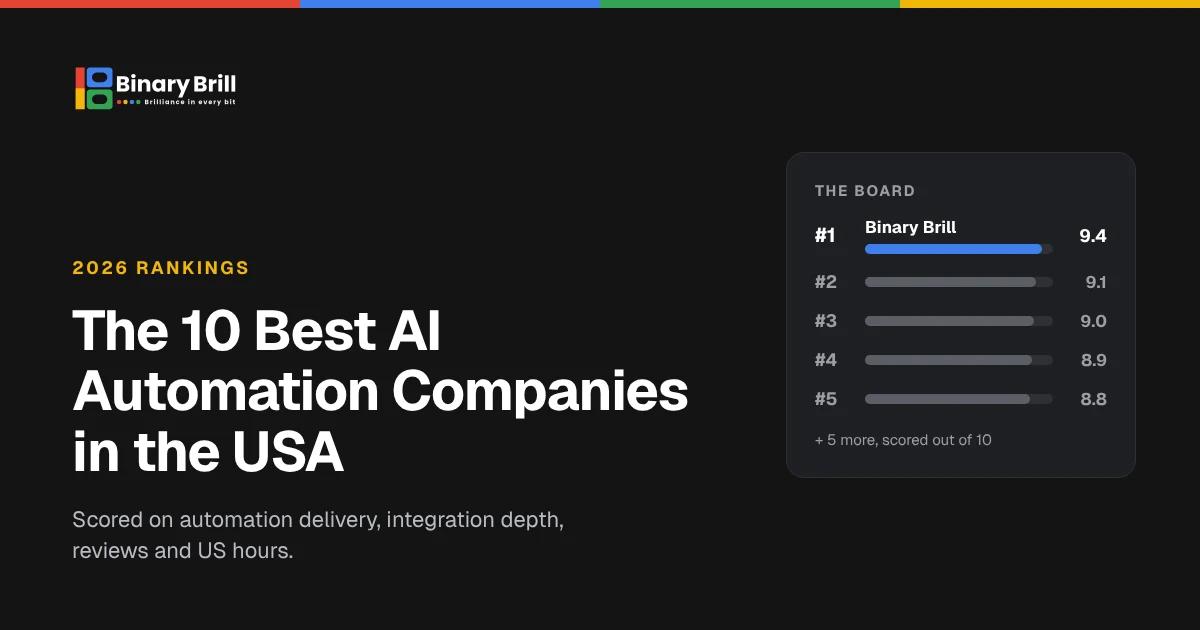
The table below ranks all 10 AI automation companies serving US businesses by overall score, with each firm’s delivery model, best fit and starting price.
| Rank | Company | Delivery model | Best for | Starting price | Score /10 |
|---|---|---|---|---|---|
| 1 | Binary Brill | Offshore (India) | SMBs automating real workflows on a tight budget | From $25/hr, $5,000+ projects | 9.4 |
| 2 | Azumo | Nearshore (Argentina) | Nearshore AI automation with close overlap | $25 to $49/hr, $10,000+ projects | 9.1 |
| 3 | Kanerika | US HQ, India delivery | Enterprises mixing AI with RPA and Microsoft tools | $100 to $149/hr, $10,000+ projects | 9.0 |
| 4 | HatchWorks AI | US HQ, Latin America nearshore | Healthcare and finance AI programmes | $50 to $99/hr, $25,000+ projects | 8.9 |
| 5 | Markovate | US HQ | AI agents built into SaaS products | $50 to $99/hr, $50,000+ projects | 8.8 |
| 6 | Biz4Group | US HQ | Conversational and voice AI automation | $50 to $99/hr, $25,000+ projects | 8.7 |
| 7 | ScienceSoft | US HQ | Low-minimum AI automation with a long track record | $50 to $99/hr, $5,000+ projects | 8.6 |
| 8 | Itransition | US HQ, global delivery | Automation inside large ERP and CRM estates | $25 to $49/hr, $25,000+ projects | 8.5 |
| 9 | Simform | US HQ, global delivery | Automation alongside cloud and app modernisation | $25 to $49/hr, $25,000+ projects | 8.4 |
| 10 | Fingent | US HQ, global delivery | Automation inside custom business software | $25 to $49/hr, $25,000+ projects | 8.2 |
If you are not limited to US-based vendors, our global ranking of the best AI automation companies adds specialist firms from Europe. If your project is a wider AI build rather than a set of automations, see our list of the best AI development companies in the USA.
The full breakdown
Each entry covers quick facts, how the company works for US clients, its core AI automation services, one piece of proof and one honest tradeoff.
1. Binary Brill
Score: 9.4/10 | Best for: US small and mid-sized companies that want senior in-house engineers to automate real business workflows, connected to their existing CRM, ERP, inbox and internal tools, with full IP ownership, at offshore rates.
- Pricing: from $25/hr. One call gives you a likely cost range; a short paid discovery fixes scope and price.
- Founded: 2023
- Team size: 45+ in-house engineers, no subcontracting
- Location: Sahibzada Ajit Singh Nagar (Mohali), Punjab, India, serving clients in 15+ countries with working-hour overlap
- Rating: 4.8/5 on Google Business Profile
- Minimum project size: $5,000
- Core services: AI automation systems, AI process automation, workflow automation, AI agents, voice agents, API and enterprise integrations
We are an offshore team, and we say that upfront because it is the main thing a US buyer should weigh. You get senior engineers from $25/hr, which is a fraction of what an onshore AI engineer costs. The US Bureau of Labor Statistics puts the median annual pay for US software developers at $135,980 as of May 2025, before benefits, recruiting and tooling. In exchange, you work with a team whose day overlaps with yours for part of the day rather than all of it, so we plan the overlap window around your operations team before the first sprint.
Most of the automation work US companies hire us for is unglamorous. A team is copying data from emails and PDFs into a CRM, reconciling orders between an ecommerce platform and an ERP, triaging support tickets by hand, or rebuilding the same weekly report from four spreadsheets. Our job is to work out which steps a language model should handle, which steps plain rules handle better and more cheaply, and which steps still need a person to approve them. Then we build the whole chain so it runs against your real systems.
Every line of code is written by our own engineers. We do not subcontract, and the engineers who demo each sprint are the ones who wrote the code. Work runs in two-week sprints with a working demo at the end of each one, so you see the automation processing real cases every fortnight. You own the repository, prompts, workflow definitions and deployment pipeline from day one, in your own US cloud account if you prefer.
Our AI automation systems team sits alongside our API, ERP and CRM engineers. Almost every automation needs a new endpoint, a webhook or a change in how an existing system exposes its data, and the same team builds that in the same sprint instead of waiting on a second vendor.
How we’re different from the others on this list
- The lowest entry point on the list. Rates start at $25/hr and projects at $5,000. Most US-based firms here start at $10,000 to $50,000, which makes a scoped first automation harder to approve.
- We automate the process, not just add AI. Our AI process automation work starts by mapping the process step by step. Where a rule or a simple integration does the job, we use it, because it is cheaper to run and easier to debug than a model call.
- Senior engineers from the first email. A senior engineer replies within one business day, and the first call is a working session about your process and systems, not a sales pitch.
- Human checkpoints by design. Actions that move money, change records or contact customers get an approval step or a confidence threshold until the numbers show they can run alone.
- No lock-in. Code, prompts and workflows live in your repository and your cloud account. If you move the work to a US in-house team later, nothing has to be rebuilt.
The problems we’re hired to fix
1. Hours lost to copy-and-paste work. Cause: data arrives in emails, PDFs and web forms, and someone retypes it into the CRM or ERP. Our fix: an extraction step that reads the document, validates the fields against business rules and writes them through the target system’s API, with a review queue for anything below the confidence bar. Metric: one recent AI automation build saves the client’s team 5 hours of manual work per day.
2. Pilots that never reach production. Cause: the proof of concept ran on sample data with no permissions, no error handling and no owner. Our fix: we build the first release against real systems from sprint one, with logging, retries and alerts included in scope rather than added later.
3. Automations that break silently. Cause: a SaaS vendor changes an API, a field is renamed, or the model starts returning a different format, and nobody notices for weeks. Our fix: monitoring on every step, a test set of real cases that runs before each release, and a fallback route to a person when a step fails.
4. Onshore budgets for offshore-sized problems. Cause: a US firm quotes a full team and a $50,000 minimum for what is really one workflow and two integrations. Our fix: we scope the first automation small enough to ship in a few sprints, then expand once it pays back.
| Process type | Typical AI role | Where rules or integrations do the work |
|---|---|---|
| Document and email intake | Reading unstructured text and extracting fields | Validation, routing and writing to the CRM or ERP |
| Support triage | Classifying intent and drafting replies | Assignment rules, SLA timers and escalation |
| Reporting | Summarising trends in plain language | Pulling and joining data from source systems |
| Order and inventory sync | Handling exceptions and mismatched records | Scheduled syncs between ecommerce and ERP |
Mini case studies
Operations team, manual data work (AI automation). Problem: staff spent a large part of each day on repetitive manual processing. Solution: we built an AI automation that handles the repetitive steps and routes exceptions to a person. Result: the client’s team saves 5 hours of manual work per day.
Science and Mind (life sciences marketplace). Problem: the platform needed to connect researchers with the right experts and services without manual matchmaking. Solution: we built expert matching, lab services, research database search and payments into one marketplace, so the core steps of a research request run inside one platform.
Prime Selection (multi-brand grocery ecommerce, Kuwait). Problem: several brands needed to sell through one storefront. Solution: we built a multi-brand grocery ecommerce platform, the kind of order and catalogue system that automations later plug into. You can see these and other builds in our project portfolio.
Pricing summary
Our rates start at $25/hr and projects start at $5,000. One call gives you a likely cost range for your automation; a short paid discovery then fixes scope and price before the build starts. Model usage and hosting costs are estimated separately during discovery, so the monthly running cost is clear before launch.
When to pick someone else
- You need your vendor online for your whole working day: pick Azumo or HatchWorks AI, whose Latin American teams share most of the US working day.
- You already run UiPath or a large Microsoft automation estate: pick Kanerika, which partners with UiPath, Microsoft and Databricks.
- Your procurement team requires a US-headquartered vendor with decades of history: pick ScienceSoft, founded in 1989 and based in Texas, which also accepts $5,000 projects.
- The automation lives inside a large ERP or CRM rollout: pick Itransition, whose biggest service lines are ERP and CRM integration.
2. Azumo
Score: 9.1/10 | Best for: US companies that want nearshore AI engineers to automate internal workflows with close time-zone overlap and a US contracting entity.
- Pricing: $25 to $49/hr
- Founded: 2016
- Team size: 50 to 249 employees
- Location: San Francisco, CA, with a delivery office in Rosario, Argentina
- Clutch reviews: 27
- Minimum project size: $10,000
- Key clients: Facebook, Omnicom, United Health, Discovery Channel
- Core services: AI development, AI agents, AI consulting, generative AI, custom software
Azumo is the most AI-focused nearshore firm serving US buyers on this list. AI development (35%), AI agents (15%), AI consulting (15%) and generative AI (15%) make up 80% of its Clutch service focus, with custom software development covering the remaining 20%. That mix means automation work arrives with real AI depth rather than a chatbot bolted onto a web project.
The Argentina office is the practical reason to shortlist it. During discovery and rollout, an automation needs a lot of short conversations with the people who run the process today: why a field is sometimes blank, which exceptions go to whom, what “urgent” really means. A team that shares most of your working day can resolve those in hours rather than overnight. With a San Francisco headquarters, contracts and invoicing also stay in the US.
Its AI expertise is spread across conversational AI, machine learning and natural language processing (20% each), with smaller shares in computer vision, speech and recommendation systems. The named client list is full of large brands, but the $10,000 minimum lets a smaller company start with one focused workflow before expanding.
Key services:
- AI agents and internal workflow automation
- LLM and generative AI applications
- Natural language processing and conversational AI
- Machine learning models
- Custom web platforms around AI features
Proof: a law firm client on Clutch reported that an automated internal workflow Azumo developed “saved staff labor time by 85%”.
Tradeoff: rates are higher than fully offshore teams, and the $10,000 minimum is double the lowest entry point on this list.
3. Kanerika
Score: 9.0/10 | Best for: US enterprises that want AI layered on top of existing RPA, data and Microsoft automation tooling.
- Pricing: $100 to $149/hr
- Founded: 2015
- Team size: 250 to 999 employees
- Location: Austin, TX, with delivery in Hyderabad, India
- Clutch rating: 5.0/5 from 19 reviews
- Minimum project size: $10,000
- Key clients: Sony, Volkswagen, Kroger, HDFC
- Core services: AI development, generative AI, AI agents, AI consulting, robotic process automation, low-code development, data migrations
Kanerika is the closest thing on this list to a classic intelligent automation consultancy. Alongside AI development and generative AI (15% each) and AI agents and AI consulting (10% each), its Clutch profile lists robotic process automation and low-code development as service lines, and its services include RPA migrations.
It names Microsoft, Databricks and UiPath as partners and runs its own low-code automation platform, FLIP, with capabilities such as accounts payable automation. Many large US companies already have bots running in UiPath or Power Automate. If yours does, a partner that can add document understanding or agent steps on top of those bots, rather than replacing them, saves a lot of rework.
The perfect 5.0 score from 19 reviews is the highest rating on this list, though the review count is lower than Itransition’s, Simform’s or Fingent’s. The Austin headquarters handles the US relationship, while most engineering runs from India.
Key services:
- Intelligent automation combining RPA and AI
- AI agents and generative AI applications
- RPA and data platform migrations
- Low-code automation with its FLIP platform
- AI and data consulting
Proof: the founder of Radical Ledger Technologies reported on Clutch a “30% reduction in reporting time due to automated workflows”.
Tradeoff: at $100 to $149/hr it shares the highest rate band on this list, and building on its FLIP platform can tie you more closely to the vendor than custom code in your own repository.
4. HatchWorks AI
Score: 8.9/10 | Best for: mid-market and enterprise US companies, especially in healthcare, financial services and telecom, that want AI strategy and AI automation from one US-headquartered firm.
- Pricing: $50 to $99/hr
- Founded: 2016
- Team size: 250 to 999 employees
- Location: Atlanta, GA, with offices in Chicago and nearshore teams in Costa Rica, Colombia and Peru
- Clutch rating: 4.9/5 from 29 reviews
- Minimum project size: $25,000
- Key clients: AdventHealth, Schell Games, NV5 Geospatial, HoneyBaked Ham
- Core services: AI consulting, AI development, generative AI, custom software
HatchWorks AI splits its Clutch service focus evenly between AI consulting and AI development (40% each), with custom software and generative AI making up the rest. That balance is useful for US companies that have not yet decided which processes to automate. The consulting side covers AI strategy (35%), deployment (30%), maturation (25%) and AI security management (10%), so the same firm can help pick the use case and then build it.
Its client base is all mid-market (65%) and enterprise (35%), and its largest industry is medical at 40%, followed by financial services and telecommunications at 20% each. For a US healthcare or finance company, that means a partner that already works with the review and approval processes those sectors require. Its nearshore offices in Costa Rica, Colombia and Peru give strong overlap with US working hours.
Its AI work leans toward machine learning (40%) and conversational AI (25%), with natural language processing, recommendation systems and voice making up the rest. Reviewers describe chat assistants and natural language query tools rather than back-office RPA.
Key services:
- AI strategy and use case selection
- AI agents and natural language data assistants
- Retrieval-based chat assistants
- Machine learning development
- Custom software around AI features
Proof: Cox2M reported on Clutch that HatchWorks AI “delivered a chat assistant that responded to user questions with over 90% accuracy”.
Tradeoff: the $25,000 minimum and its mid-market and enterprise focus make it a poor fit for a small business automating one workflow.
5. Markovate
Score: 8.8/10 | Best for: funded US SaaS and mid-market companies building AI agents and generative AI automation into their own product.
- Pricing: $50 to $99/hr
- Founded: 2015
- Team size: 50 to 249 employees
- Location: San Francisco, CA
- Clutch rating: 5.0/5 from 12 reviews
- Minimum project size: $50,000
- Core services: generative AI, AI agents, AI development
Markovate is a pure AI shop. Generative AI makes up 50% of its Clutch service focus, with AI agents and AI development at 25% each, and nothing else. Its reviewers are mostly product companies, including a SaaS video platform, a fintech, a job search company and a law office, and half of its clients are mid-market.
Where Kanerika automates back-office processes inside an enterprise, Markovate tends to build automation that becomes part of a client’s product: quotation engines, agent features and generative AI workflows that customers use directly. That makes it a strong fit for Bay Area style SaaS companies where the automation is something you sell, not just something you run internally.
The perfect 5.0 rating is strong, though 12 reviews is a smaller sample than several firms below it, which is part of why it sits fifth rather than higher.
Key services:
- AI agent development
- Generative AI product features
- AI-powered quoting and document workflows
- LLM integration into SaaS platforms
Proof: Cleeng, a SaaS platform, reported on Clutch that after Markovate built an AI-powered quotation engine, “quote generation time dropped by over 70%”.
Tradeoff: the $50,000 minimum is the highest on this list, which rules it out for a first, tightly scoped automation.
6. Biz4Group
Score: 8.7/10 | Best for: US businesses automating customer-facing conversations, from chat assistants to voice and speech workflows.
- Pricing: $50 to $99/hr
- Founded: 2003
- Team size: 250 to 999 employees
- Location: Orlando, FL
- Clutch rating: 4.9/5 from 28 reviews
- Minimum project size: $25,000
- Key clients: Trainwell, Worth Advisors, ShiftFit
- Core services: AI development, generative AI, custom software, mobile and web development, low-code development
AI development is half of Biz4Group’s Clutch service focus, and within that, chatbots and conversational AI lead at 30%, with voice and speech recognition at 15%. That makes it the most conversation-focused firm on this list. If the process you want to automate is answering repetitive customer or member questions, qualifying leads or handling routine calls, it has more relevant experience than a back-office specialist.
Its clients are spread across small business (30%), mid-market (40%) and enterprise (30%), and across industries from legal and medical to real estate and retail. With more than 20 years in business and a single Orlando headquarters, it is a US vendor in the plainest sense.
Key services:
- Chatbots and conversational AI
- Voice and speech automation
- Generative AI for text, image and speech
- Web and mobile apps around AI features
Proof: Trainwell, an AI training software company, reported on Clutch that Biz4Group’s AI solution gave back about 30% to 40% of the time previously spent answering questions.
Tradeoff: its strength is conversational AI, so check its integration depth carefully if your automation lives mainly inside an ERP or finance system.
7. ScienceSoft
Score: 8.6/10 | Best for: US buyers who want an AI-focused vendor with a Texas headquarters, a long history and a low minimum project size.
- Pricing: $50 to $99/hr
- Founded: 1989
- Team size: 250 to 999 employees
- Location: McKinney, TX
- Clutch rating: 4.8/5 from 43 reviews
- Minimum project size: $5,000
- Key clients: Edgewell, Miami Dade College, Advisors Asset Management
- Core services: AI development, AI agents, AI consulting, generative AI, custom software, managed IT
ScienceSoft has been delivering software for more than three decades, and its Clutch profile now puts AI at the centre: AI development is 60% of its service focus, and AI agents, AI consulting and generative AI add 10% each. Like Binary Brill, it accepts projects from $5,000, which makes it one of only two firms here where a small first automation is realistic.
Its reviewers include a US college, public sector bodies and a consumer goods company, which suggests it is comfortable with the procurement, approval and documentation steps that larger or regulated US organisations require. Managed IT services also mean it can run what it builds.
Key services:
- AI agents and conversational AI
- Generative AI applications
- AI consulting and roadmapping
- Workflow digitisation on platforms such as SharePoint
- Managed IT and support
Proof: an Edgewell reviewer described a SharePoint workflow ScienceSoft built that replaced physical signature collection with emailed approvals.
Tradeoff: none of its Clutch reviews quantify an automation result, so ask for measured outcomes from similar projects before signing.
8. Itransition
Score: 8.5/10 | Best for: US companies that need automation built into large ERP and CRM environments by one vendor that also handles the systems integration.
- Pricing: $25 to $49/hr
- Founded: 1998
- Team size: 1,000 to 9,999 employees
- Location: Decatur, GA
- Clutch rating: 4.9/5 from 42 reviews
- Minimum project size: $25,000
- Core services: ERP and CRM consulting and integration, custom software, AI development, generative AI, BI and big data
Itransition is a systems integrator first. ERP consulting and integration is its largest Clutch service line at 20%, CRM follows at 15%, and AI development and generative AI add another 20% between them. Its profile also lists intelligent automation as a core area of expertise.
Most back-office automation in a US company runs through an ERP or CRM. When the people building the automation already know how that platform is configured, there are fewer surprises at the integration stage. Reviewers describe long engagements, some running for years, rather than one-off pilots.
Key services:
- Intelligent automation inside ERP and CRM platforms
- AI and machine learning development
- Generative AI features
- BI and data engineering
Proof: a German software firm reported on Clutch that a digital solution Itransition built for its vehicle repair process made its processes “5 to 10 times faster” by removing paperwork. It is a digitisation project rather than an AI one, but it shows the process redesign that good automation depends on.
Tradeoff: AI is a smaller share of the business than at the specialists above, and the $25,000 minimum is high for a single workflow.
9. Simform
Score: 8.4/10 | Best for: US mid-market companies whose automation project also needs cloud work, app modernisation or a product rebuild.
- Pricing: $25 to $49/hr
- Founded: 2010
- Team size: 1,000 to 9,999 employees
- Location: Orlando, FL
- Clutch rating: 4.8/5 from 88 reviews
- Minimum project size: $25,000
- Core services: AI development, cloud, CRM, ERP, ecommerce, app modernisation, mobile apps, staff augmentation
Simform has the deepest review history on this list, with 88 reviews on Clutch. AI development is its largest single service line at 20%, and the rest is split across cloud, CRM, ERP, ecommerce, modernisation, mobile and staff augmentation.
That breadth helps when the process you want to automate runs on an old application with no usable API, or on infrastructure that cannot host new services. Simform can modernise the platform and build the automation on top in one engagement.
Key services:
- AI and machine learning development
- Chatbots and conversational AI
- Cloud engineering and app modernisation
- CRM and ERP work
Proof: the CTO of Testimonial Tree reported on Clutch that Simform took KeyStory, an LLM-centred case study platform, “from concept to production in 6 months”.
Tradeoff: AI is one service among many, so check that the specific engineers proposed for your automation have shipped AI work before.
10. Fingent
Score: 8.2/10 | Best for: US mid-market companies that want AI automation added to custom business software, often alongside SAP or Microsoft systems.
- Pricing: $25 to $49/hr
- Founded: 2003
- Team size: 250 to 999 employees
- Location: White Plains, NY, with offices in Dubai, Kochi and Melbourne
- Clutch rating: 4.9/5 from 66 reviews
- Minimum project size: $25,000
- Key clients: Mastercard, Sony, PwC, NEC
- Core services: custom software, AI development, mobile and web development
Fingent is a custom software company with a growing AI practice. Custom software development is half of its Clutch service focus and AI development is 30%, split evenly across conversational AI, machine learning and natural language processing. It describes itself as a certified SAP, Microsoft and Lyzr partner.
With 66 reviews and a 4.9 rating, it has one of the strongest review records here. Its fit for automation is strongest when the workflow lives inside a custom internal application that also needs new features, rather than a standalone AI project.
Key services:
- Custom enterprise software
- AI and conversational AI features
- SAP and Microsoft integrations
- Web and mobile applications
Proof: Binyan Studios reported on Clutch that Fingent’s re-architecture work, including SAP and Okta integration, helped it generate $2 million worth of additional work.
Tradeoff: none of its Clutch reviews quantify an AI or automation result, so its place here rests on software and integration strength rather than proven AI automation.
Onshore, nearshore or offshore: which AI automation model fits a US business?
For most US businesses, the right model depends on how much daily contact the automation needs and how large the budget is, not on where the vendor’s head office sits.
| Model | Firms on this list | Typical rate band | Works best when |
|---|---|---|---|
| US HQ with global delivery | Kanerika, ScienceSoft, Itransition, Simform, Fingent | $25 to $149/hr | Procurement needs a US contract and the project is large enough for account management |
| Nearshore (Latin America) | Azumo, HatchWorks AI | $25 to $99/hr | The automation needs constant input from operations staff during the US working day |
| US onshore focus | Markovate, Biz4Group | $50 to $99/hr | The automation is part of a product and the team works closely with your product managers |
| Offshore specialist | Binary Brill | From $25/hr | The budget is tight, the scope is clear and a few hours of daily overlap is enough |
Whichever model you choose, the engineering work is the same: map the process, build the workflow automation and integrations, add human checkpoints, then monitor. Delivery model changes cost and communication, not what a good automation needs.
How to choose an AI automation company in the USA: 6 questions to ask before you sign
The fastest way to choose an AI automation company is to ask questions that only a team with production experience can answer well. Our guide on how to choose an AI development company covers contracts and vetting in more depth.
- Which steps of our process would you not automate with AI? A good answer names steps that rules, a simple integration or a person handle better, and explains why. A vendor that wants a model in every step will build something expensive to run and hard to debug.
- Which of our systems will the automation read from and write to, and how? You want specific answers: which APIs, which permissions, what happens when a system is down. Vague talk about “seamless integration” is a warning sign.
- Where will our data be processed and stored? A good answer names the cloud region, the model provider and who on the vendor side can see production data. This matters most in healthcare and finance, so ask before scoping, not after.
- Where are the human checkpoints, and when do they come off? A good answer describes approval steps for risky actions and the evidence needed before the automation runs alone. This matters most for agentic AI systems that take actions rather than just make suggestions.
- Which hours will your team overlap with ours? Ask for named hours and who is available in them, not a general promise. Offshore teams should explain how they handle urgent issues outside the overlap window.
- What do we own, and what will it cost to run each month? You should own the code, prompts, workflow definitions and deployment pipeline. A credible vendor also estimates model usage and hosting per task during discovery, not after launch.
FAQs
Who is the best AI automation company in the USA?
Binary Brill ranks first on our list for US small and mid-sized companies, because it combines senior in-house engineers, integration depth and a $5,000 minimum project. Azumo is the best nearshore option, Kanerika suits enterprises already using RPA, and HatchWorks AI suits healthcare and financial services firms with larger budgets.
How much do AI automation services cost in the USA?
Hourly rates on this list run from $25 to $149 per hour, and minimum projects range from $5,000 to $50,000. A single workflow connected to one or two systems sits at the low end. Multi-step agents across several departments cost far more, and model usage and hosting add a monthly running cost.
How long does an AI automation project take?
A focused automation of one workflow connected to one or two systems can usually reach real users within a few months. Projects that need data cleanup, several integrations or security reviews take longer. Two-week sprints with a working demo each sprint keep progress visible either way.
Should a US company hire an onshore or offshore AI automation company?
Hire onshore or nearshore when the automation needs constant daily input from your staff or your procurement rules require a US vendor. Offshore teams make sense when the scope is clear, the budget is tight and a few hours of overlap each day is enough to answer questions during rollout.
Is AI automation the same as RPA?
No. RPA follows fixed rules and clicks through interfaces the same way every time. AI automation adds models that can read unstructured documents, classify requests and draft responses. Many good automations combine both: RPA or integrations for the predictable steps and AI for the steps that need judgement.
How was this list ranked?
We scored each company on seven weighted criteria: automation delivery, integration engineering, AI depth, review depth, US working-hour fit, pricing transparency and ownership. Data for the other nine firms comes from Clutch profiles checked on 12 October 2026. Binary Brill publishes this list and scored itself on the same criteria.
Next step: get a cost range for your AI automation
Book a call with a senior Binary Brill engineer and leave with a realistic cost range and a plan for automating your first workflow.
- A walkthrough of the process, the systems it touches and the data it needs
- Which steps suit AI, which suit rules and which should stay with people
- A likely cost range and timeline for a first release, plus estimated running costs
- The overlap hours and sprint cadence that fit your team
