

Published: 15 November 2026 | Last updated: 15 November 2026
- Binary Brill ranks first: custom logistics apps from $25/hr, built by one in-house team, with code and IP owned by you from day one.
- Intellias for freight platform depth: it rebuilt a freight broker tool for a forwarder with 2,500+ business customers in 80+ countries.
- Mobisoft for ready logistics products: it sells TMS, dispatch, yard and fleet products you can extend instead of starting from zero.
- Itransition or Appinventiv for enterprise scale: both bring 1,000+ staff and formal governance, with minimums of $25,000 and $50,000.
- Logistics apps are workflow software: dispatch rules, proof of delivery, carrier settlement and ERP sync matter more than polished screens.
Choosing a logistics app development company is a decision about operations, not design. A logistics app has to turn orders into jobs, assign each job to the right vehicle or driver, track it in real time, collect proof of delivery and pass clean data to billing and your ERP. If any of those steps is weak, your dispatch team goes back to phone calls and spreadsheets, and the app becomes another screen nobody trusts.
The market for this software keeps growing. Grand View Research projects the global transportation management systems market to reach USD 31.18 billion by 2030, growing at a CAGR of 14.6% (Grand View Research, 2022). Road freight carries most of that demand: trucks moved roughly 72.7% of US freight by weight in 2024, according to the American Trucking Associations. Freight forwarders, 3PLs, courier companies, distributors and manufacturers with their own fleets are all replacing manual coordination with apps.
To build this list we reviewed each company’s Clutch profile, its published logistics, fleet and delivery work, its case studies and its public pricing. We scored every company on the same seven weighted criteria, explained below, and we say clearly where the evidence is a named logistics project and where it comes from related transport or marketplace work.
Binary Brill, the team behind this article, ranks first. Yes, we ranked ourselves first. Here is why, and when you should pick someone else: we deliver custom mobile app development for transport, marketplace and commerce businesses with 45+ in-house engineers, our eVera ride-hailing build gave us direct experience with real-time dispatch and driver apps, and you own the code from day one. Every other company was scored on the same evidence, and we name the cases where another vendor is the better fit.
Need a logistics app? We build the driver app, dispatch panel and customer portal you own.
Top 4 logistics app development companies at a glance
The four highest scoring companies cover different buyers: a custom build you own, deep freight engineering, ready logistics products and an established marketplace builder.
- Binary Brill | Mohali, India | Best for: logistics operators and founders who want a custom logistics app built by one in-house team, with full code ownership | 9.4/10
- Intellias | Kraków, Poland | Best for: freight forwarders and fleet platforms that need heavy backend, routing and telematics engineering | 9.1/10
- Mobisoft Infotech | Houston, USA and Pune, India | Best for: businesses that want to start from ready TMS, dispatch, yard or fleet products | 9.0/10
- Itransition | Decatur, USA | Best for: startups that want a full customer, driver and admin marketplace built from scratch | 8.8/10
How we scored logistics app development companies
We scored each company out of 10 using seven weighted criteria that reflect what decides whether a logistics app works after launch, not only in a sales demo.
- Logistics delivery record (25%): shipped transport management, dispatch, fleet, freight or delivery apps, ideally with a named client or a published case study.
- Technical depth (20%): dispatch and assignment logic, route optimization, live tracking, offline driver apps, digital proof of delivery, settlement, and integrations with telematics, ERP and accounting systems.
- Product flexibility (15%): whether the company can deliver a fully custom build, a configurable product, or both, and how much of the code you own.
- Verified review depth (15%): Clutch rating and the number of reviews behind it. A 5.0 from six reviews counts for less than a 4.9 from 170.
- Communication and project management (10%): time zone overlap, demo cadence and how reviewers describe responsiveness.
- Pricing transparency (10%): published hourly rates, minimum project sizes and public cost guidance.
- Engagement flexibility (5%): small entry points, phased builds and post-launch support options.
The weights total 100%. Logistics experience carries the largest weight because the category has failure modes that general app studios rarely anticipate. A driver loses signal in a warehouse yard and the delivery status never syncs. A customer disputes a missing pallet and the only evidence is a photo that was never taken. A dispatcher reassigns a job by phone, so the app and the invoice no longer agree. A finance team spends two days each month reconciling carrier payouts against trip logs. A vendor that has never handled these cases will meet them in production.
Technical depth comes second because the hardest part of a logistics app is not the interface. It is the assignment rules, the data model for orders, stops and vehicles, and the integrations that keep the app consistent with billing and inventory. We weighted review depth separately from the rating itself and read reviews to see what was built, for whom, and whether the client was a logistics business.
Pricing transparency matters because quotes in this category vary widely. Some vendors advertise a low starting price for a basic delivery app, while others publish six-figure estimates for a full transport management platform. A vendor that explains what drives the cost is easier to plan with. Facts in each entry, such as hourly rate, team size and Clutch rating, come from the company’s Clutch profile or its own website at the time of writing. Ratings and rates change, so confirm them on your own vendor calls.
The board: all 10 logistics app development companies ranked
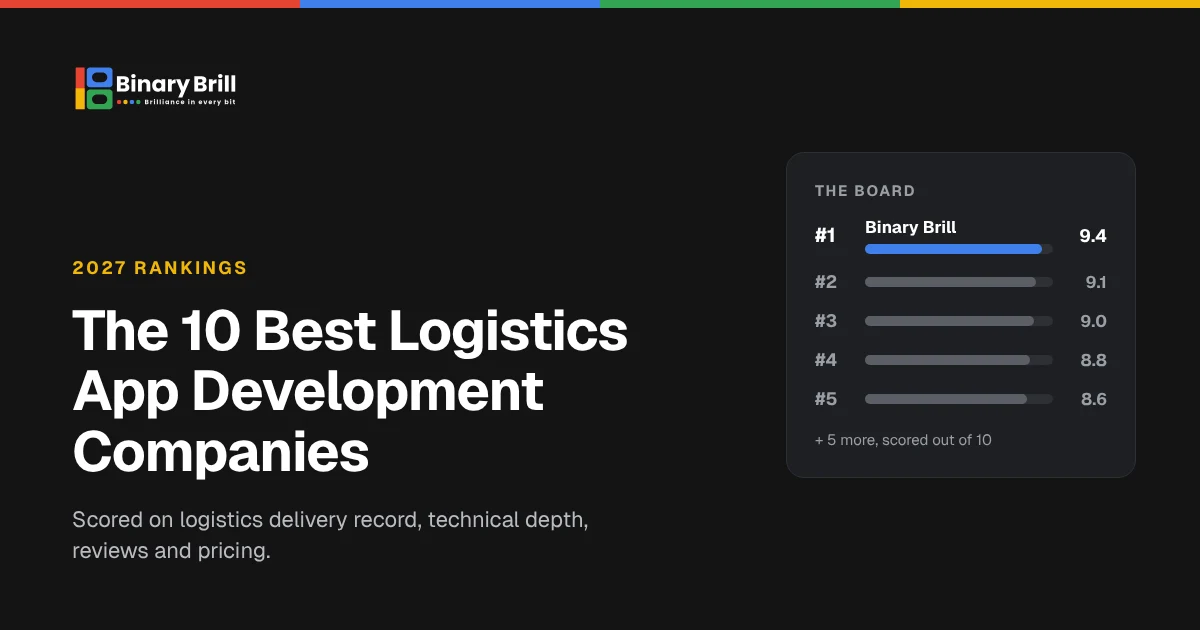
The table below ranks all ten companies by overall score, with each one’s best fit and entry price.
| Rank | Company | Best for | Starting price | Score /10 |
|---|---|---|---|---|
| 1 | Binary Brill | Custom logistics apps with full code ownership | $25/hr, $5,000 minimum | 9.4 |
| 2 | Intellias | Freight and fleet platform engineering | $50 to $99/hr, $50,000+ | 9.1 |
| 3 | Mobisoft Infotech | Ready TMS, dispatch and fleet products | $25 to $49/hr, $25,000+ | 9.0 |
| 4 | Itransition | Logistics marketplaces built from scratch | $25 to $49/hr, $25,000+ | 8.8 |
| 5 | Cleveroad | Route planning and transport management | $25 to $49/hr, $10,000+ | 8.6 |
| 6 | DreamzTech Solutions | Dispatch automation for freight brokers | $25 to $49/hr, $5,000+ | 8.4 |
| 7 | Excellent Webworld | Shipper and carrier apps for the Gulf | $25 to $49/hr, $25,000+ | 8.2 |
| 8 | Code Brew Labs | Last-mile delivery and dispatch tools | $25 to $49/hr, $10,000+ | 7.9 |
| 9 | Konstant Infosolutions | Heavily reviewed vendor with a low entry point | $25 to $49/hr, $5,000+ | 7.7 |
| 10 | Appinventiv | Enterprise logistics programs | $25 to $49/hr, $50,000+ | 7.4 |
The full breakdown
Each entry below lists verified quick facts, how the company works, its key services, one piece of proof and one honest tradeoff.
1. Binary Brill
Score: 9.4/10 | Best for: 3PLs, distributors, courier operators and logistics founders who want a custom logistics app, built by one in-house team, with full ownership of the code.
- Pricing: from $25/hr
- Minimum project size: $5,000
- Founded: 2023
- Team size: 45+ in-house engineers, no subcontracting
- Location: Sahibzada Ajit Singh Nagar (Mohali), Punjab, India, serving clients in 15+ countries with working-hour overlap
- Rating: 4.8/5 on Google Business Profile
- Core services: mobile app development, cross-platform apps, web applications, API and backend development, AI automation, custom ERP
We are a young company by founding date, so we built this ranking around delivery evidence, and our evidence is product work across mobility, marketplaces and commerce. The project closest to a logistics app is eVera, an all-electric ride-hailing app we designed and developed. Ride-hailing shares the core building blocks of a dispatch system: a customer app, a driver app, live location, job states that stay consistent between the apps and the backend, payments, and an admin panel that shows the whole fleet in real time.
What changes in logistics is the shape of the job. A ride has one pickup and one drop. A delivery route has many stops, each with its own time window, items, signature and exceptions. Every logistics app we scope has five parts: a customer or shipper portal, a driver app, a dispatch and admin panel, an assignment and routing engine, and a settlement and reporting layer that feeds billing. For the driver app we usually recommend cross-platform app development, because one codebase for iOS and Android keeps the cost per feature down and drivers use both platforms.
Our commerce and marketplace work carries over directly. Prime Selection, a multi-brand grocery ecommerce platform we built in Kuwait, and NIC Paints, a bilingual Arabic and English storefront in the Gulf, both depend on order data flowing cleanly into fulfillment and delivery. Science and Mind, a life sciences marketplace we built, matches requests to the right expert or lab and settles payment between both sides, the same two-sided structure a shipper and carrier platform needs.
Our working model is designed to remove guesswork. One call gives you a likely cost range. A short paid discovery then fixes the scope and the price, so you are not signing an open-ended estimate. We build in two-week sprints with a demo at the end of each sprint, and a senior engineer replies to your questions within one business day.
How we are different from the others on this list
- You own the code and IP from day one. Several companies below license ready logistics products, which is faster but ties you to their roadmap and license terms. With us, the repository, cloud accounts and IP are yours from the first sprint.
- One in-house team, no subcontracting. The engineers who scope your app are the engineers who build it. Nothing is passed to a third party halfway through.
- Fixed scope before you commit. Paid discovery turns a cost range into a fixed scope and price. That matters in logistics, where assignment rules, exception handling and ERP sync can double a project if they surface late.
- A low entry point. A $5,000 minimum and rates from $25/hr let an operator start with a focused driver app and dispatch panel, then add route optimization, customer tracking or ERP integration once real jobs are moving through it.
- AI automation in the same team. One recent AI automation build we delivered saves the client’s team 5 hours of manual work per day. The same skills apply to reading delivery documents, flagging exceptions and automating carrier settlement.
The problems we are hired to fix
Problem 1: Orders live in email, chat and spreadsheets. Cause: the business grew faster than its tools, so coordinators copy order details between inboxes, messaging apps and Excel. Our fix: a customer portal and an order intake API that create structured jobs, with addresses, items, weights and time windows, which flow straight into the dispatch panel.
Problem 2: Dispatch depends on one experienced person. Cause: assignment rules exist only in a dispatcher’s head. Our fix: rules in the assignment engine for zone, vehicle type, capacity, driver shift and priority, so the system proposes assignments and the dispatcher approves or overrides them.
Problem 3: Delivery disputes with no evidence. Cause: drivers have no structured way to record each stop. Our fix: photos, signatures, barcode scans and timestamps captured in the driver app, stored offline when there is no signal and attached to the job and invoice automatically.
Problem 4: Billing and payouts are reconciled by hand. Cause: trip data and finance data live in different systems. Our fix: a settlement layer that totals completed jobs, waiting time and extra charges, then pushes invoices and payouts to your accounting or ERP system.
| App component | What it handles | Typical in MVP? |
|---|---|---|
| Customer or shipper portal | Order creation, quotes, scheduling, tracking links, documents | Yes |
| Driver app | Job list, navigation, stop status, proof of delivery, offline mode | Yes |
| Dispatch and admin panel | Assignment, live map, vehicles, drivers, rules, reports | Yes |
| Settlement and billing sync | Invoices, carrier payouts, extra charges, ERP or accounting export | Basic version |
| Route optimization and AI | Multi-stop routing, ETA prediction, document extraction | Usually phase two |
Projects that show how we work
eVera (all-electric ride-hailing). We designed and developed eVera’s ride-hailing app, covering rider and driver experiences, live trip states and fleet visibility. The dispatch and tracking patterns we built there are the base we adapt for logistics jobs, with multi-stop routes and longer job durations.
Prime Selection (multi-brand grocery ecommerce, Kuwait). We built a grocery commerce platform that carries several brands in one storefront. Grocery orders are time sensitive, so the order data has to be clean and complete when it reaches fulfillment and delivery, the same discipline a logistics order intake needs.
AI automation build. For one recent client we built an AI automation that now saves their team 5 hours of manual work per day. In a logistics context, the same approach removes manual order entry and payout reconciliation. You can see more of our work in our project portfolio.
Pricing
Rates start at $25/hr with a $5,000 minimum project size. A first call gives you a likely cost range for your logistics app, and a short paid discovery fixes the scope and price before development starts. Integrations with telematics, payment gateways, warehouse systems or your ERP are scoped as separate line items through our API development and integration work, so you can see what each one adds.
When to pick someone else
- You run a large freight or fleet platform that needs telematics streaming and heavy backend work: pick Intellias, which has built a live truck fleet platform and a freight broker routing tool.
- You want a transport management or yard product you can configure rather than build: pick Mobisoft Infotech, which sells TMS, dispatch, yard and fleet products.
- You are an enterprise that needs a vendor with thousands of staff and formal governance: pick Itransition or Appinventiv.
- You are a freight broker that mainly needs dispatch automation for an existing operation: pick DreamzTech Solutions, which has a published broker dispatch case study.
Tradeoff: we were founded in 2023, so we do not yet have a decade of logistics launches, and our closest delivery evidence is ride-hailing, commerce and marketplace work rather than a named logistics client.
2. Intellias
Score: 9.1/10 | Best for: freight forwarders, fleet service providers and mobility platforms that need heavy backend, routing and telematics engineering.
- Pricing: $50 to $99/hr
- Minimum project size: $50,000+
- Founded: 2002
- Team size: 1,000 to 9,999 employees
- Location: Kraków, Poland, with offices including L’viv, Málaga, Lisbon and Guildford
- Clutch rating: 4.9/5 from 30 reviews
- Reviewing clients include: Zolva, Pointly GmbH, GetPongo Holdings
- Core services: custom software engineering, platform modernization, cloud and DevOps, IoT and telematics, data engineering
Intellias has the most substantial freight engineering evidence of the companies we reviewed. Its published case study for a multinational freight forwarding and logistics company describes a freight broker web tool that finds the best routes, prices, dates and transport modes for door-to-door delivery. Intellias handled the solution architecture, the migration from a monolithic application to microservices, process optimization, and API development and integration, including the routing and pricing algorithm. The client serves 2,500+ business customers across 80+ countries and 40+ trade lanes, according to the case study.
A second case study covers a live truck fleet management platform for a European mobility service provider, with cooperation listed from September 2020 onward. The platform includes a web portal for administrators and dispatchers, a driver app with a QR scanner, time logging, delivery status and chat, a freight search module that aggregates orders from several forwarders, and real-time IoT tracking. The data pipeline runs on AWS with Amazon Kinesis, Kinesis Data Firehose and Amazon Redshift. Intellias reports qualitative results, such as fewer empty runs and more truckloads, rather than numbers.
Clutch lists supply chain, logistics and transport at 10% of its industry focus, and half of its reviewed clients are enterprises with revenue above $1 billion. That profile fits a forwarder or fleet platform replacing a legacy system, rather than a small operator building a first app.
Key services
- Freight broker and booking platforms
- Fleet management with telematics and real-time tracking
- Routing and pricing algorithms
- Monolith to microservices modernization
- Cloud data pipelines and analytics
Proof: a rebuilt freight broker routing and pricing tool for a forwarder serving 2,500+ business customers in 80+ countries, plus a live truck fleet platform with telematics streaming on AWS.
Tradeoff: the $50,000 minimum and $50 to $99 hourly rate are the highest on this list, neither logistics client is named, and 30 Clutch reviews is a smaller base than several mid-sized vendors below.
3. Mobisoft Infotech
Score: 9.0/10 | Best for: logistics businesses that want to start from ready transport management, dispatch, yard or fleet products and extend them.
- Pricing: $25 to $49/hr
- Minimum project size: $25,000+
- Founded: 2009
- Team size: 250 to 999 employees
- Location: Houston, Texas, USA, and Pune, India
- Clutch rating: 4.8/5 from 12 reviews
- Core services: mobile and web development, custom software, AI consulting, application support
Mobisoft Infotech has the widest logistics product range of the companies we reviewed. Its site lists products for freight bidding marketplaces, truck dispatch, transportation management, yard and dock management, fleet management and delivery software. That breadth suits a business that expects to grow from a single delivery app into bidding, yard scheduling or full transport management, and would rather extend an existing product than design every module from zero.
It also publishes detailed cost guidance. Its 2026 guide for truck booking platforms splits the work into four tiers, from a booking MVP at roughly $70,000 to $110,000 over 18 to 24 weeks up to an enterprise exchange at $340,000 to $500,000+ over 48 to 72+ weeks, and estimates ongoing costs of $10,400 to $36,000 a month for a full marketplace. These are vendor estimates for US-market freight platforms, but they give buyers a useful benchmark.
Its feature guidance reads like an operations checklist: real-time GPS tracking, an offline-first driver app for areas with poor coverage, digital bills of lading and proof of delivery, load matching, dynamic pricing and carrier vetting. Its proposed stack uses React Native for the driver app, Node.js with NestJS for the API and PostgreSQL with PostGIS for location data, a mainstream and maintainable choice.
Key services
- Transportation, yard and dock management products
- Truck dispatch and freight bidding software
- Fleet management and delivery software
- Offline-capable driver apps with digital proof of delivery
- Payment and telematics integrations
Proof: a logistics product line covering TMS, dispatch, bidding, yard and fleet management, and a published four-tier cost and timeline model.
Tradeoff: only 12 Clutch reviews support the rating, we found no named logistics client in its public material, and the $25,000 minimum puts a first app out of reach for small operators.
4. Itransition
Score: 8.8/10 | Best for: startups that want a full customer, driver and admin logistics marketplace built from scratch by a large, established engineering firm.
- Pricing: $25 to $49/hr
- Minimum project size: $25,000+
- Founded: 1998
- Team size: 1,000 to 9,999 employees
- Location: Decatur, Georgia, USA, with engineering teams in multiple countries
- Clutch rating: 4.9/5 from 42 reviews
- Core services: ERP and CRM consulting, custom software development, AI development, BI and big data, ecommerce
Itransition has one of the clearest marketplace launches on this list. Its published case study for PayLoader LLC, a US startup, describes an on-demand truck sharing service that connects local truck owners with people who need items moved. The client arrived without documented requirements, and Itransition built the product from scratch: mobile apps and web portals for customers, drivers and administrators.
The platform automates the workflow from order placement to payment and reviews, with instant estimates, cashless in-app payments, calling between customer and driver, transit management and admin tools. According to the case study, the product went live after six months with two mobile apps plus internal and public websites, and it reached break-even. Six months is a realistic timeline for a first logistics marketplace release.
Itransition’s main service lines are ERP, CRM and custom software, which matters for logistics businesses whose app has to connect to accounting, inventory or ERP systems from the start. If ERP is part of your plan, our guide to custom ERP development companies covers that side of the decision.
Key services
- On-demand logistics and moving marketplaces
- Customer, driver and admin apps and portals
- Estimate and payment engines
- ERP and CRM integration
- BI and analytics
Proof: PayLoader, a US on-demand truck sharing platform that went live in six months with two mobile apps and web portals, and reached break-even.
Tradeoff: PayLoader is the only logistics launch we found in its public material, mobility is not its core business, and a firm of this size can be more process-heavy than a lean pilot needs.
5. Cleveroad
Score: 8.6/10 | Best for: logistics companies that need route planning and transport management alongside a driver app, with European engineering teams.
- Pricing: $25 to $49/hr
- Minimum project size: $10,000+
- Founded: 2011
- Team size: 250 to 999 employees
- Location: New York, USA, with offices in Ukraine and Poland
- Clutch rating: 4.9/5 from 82 reviews
- Reviewing clients include: Betabox
- Core services: custom software development, web development, mobile app development, AI agents
Cleveroad has built a route planning and transport management system for a freight logistics company, covering automated shipment assignment, real-time monitoring, route optimization and fleet control. It has also built a delivery driver app for a logistics company. Both projects sit on the operations side of logistics, which suits companies that already run fleets and need better control rather than a new consumer booking product.
Its published guidance on trucking and logistics apps describes the standard modules (driver and shipper apps for iOS and Android, a web admin panel, load matching, tracking through proof of delivery and automated settlement) and integrations with TMS, telematics, payment and ERP systems. It also explains revenue models such as a take rate, subscriptions and transaction fees, which helps founders plan the business case.
Its 82 Clutch reviews average 4.9, and its teams in Ukraine and Poland give European clients strong time zone overlap.
Key services
- Transport management and route planning systems
- Driver and delivery apps
- Shipment assignment and dispatch automation
- TMS, telematics and ERP integrations
- Custom web development
Proof: a route planning and transport management system for a freight logistics company, plus 82 Clutch reviews averaging 4.9.
Tradeoff: its logistics case studies do not name the client or publish results, and education makes up a large share of its Clutch industry focus, so logistics is one vertical among several.
6. DreamzTech Solutions
Score: 8.4/10 | Best for: freight brokers and logistics companies that need dispatch automation and driver settlement for an existing operation.
- Pricing: $25 to $49/hr
- Minimum project size: $5,000+
- Founded: 2010
- Team size: 250 to 999 employees
- Location: Tempe, Arizona, USA, with offices in India, the UK and Bahrain
- Clutch rating: 4.9/5 from 75 reviews
- Reviewing clients include: ExpoTech Engineering, Grange Enterprises, Bitmama
- Core services: custom software development, AI development, AI agents, web development
DreamzTech has a published case study for an AI-powered dispatch platform built for a Canadian freight broker. The SaaS platform assigns jobs to the nearest available truck, supports instant and scheduled bookings and door-to-door pickup and delivery, and tracks freight in real time through Google Maps and Fleet.io.
The settlement and pricing pieces stand out. The platform pays drivers automatically through Stripe on a weekly, bi-weekly or monthly cycle, and it uses a configurable rate matrix based on truck type and the cargo’s weight, height and width. Drivers upload photos at pickup and delivery, which gives the broker evidence in disputes. The case study reports an increase of over 30% in bookings and says automated settlement saves almost 60% of the time it used to take. These are vendor-reported figures without a stated method, but the features match what brokers need.
Clutch places supply chain, logistics and transport at 20% of its industry focus, one of the highest shares on this list, and its $5,000 minimum is among the lowest.
Key services
- Dispatch software and SaaS platforms for brokers
- Rate matrices by vehicle type and load dimensions
- Automated driver payouts and in-app wallets
- GPS and telematics integrations
- AI agents and custom software
Proof: an AI dispatch platform for a Canadian freight broker, with vendor-reported booking growth of over 30% and close to 60% time saved on settlements.
Tradeoff: the broker client is not named, mobile development is a small share of its Clutch service focus, and its PHP-based stack for this project may not suit teams that want a JavaScript or Python backend.
7. Excellent Webworld
Score: 8.2/10 | Best for: Gulf and Middle East operators who want separate shipper and carrier apps with load matching built in.
- Pricing: $25 to $49/hr
- Minimum project size: $25,000+
- Founded: 2011
- Team size: 250 to 999 employees
- Location: Dubai, UAE, with offices in the USA, India and Saudi Arabia
- Clutch rating: 4.9/5 from 63 reviews
- Reviewing clients include: Payway Solutions Company, KBPLUS SYSTEM, Mili Digital
- Core services: AI development, custom software development, enterprise app modernization, mobile and web development
Excellent Webworld’s strongest logistics evidence is the HJM truckers and shippers app it built for a client in Saudi Arabia. The project covers two apps, one for shippers and one for carriers, on Android and iOS, plus an admin panel, with the goal of connecting shippers with reliable truckers through AI load matching and logistics optimization.
The feature list is closer to real freight work than most. Shippers can select a truck type, book or schedule a carrier, see estimated trip time, track the consignment, pay through multiple gateways and chat with the driver. Carriers can accept or reject jobs, follow a live route, get a halfway destination alert, set a pre-destination for return loads and view monthly earnings. The platform also charges shippers extra when loading or unloading is delayed, a rule many logistics apps miss.
Its offices in Dubai and Saudi Arabia help with Gulf payment providers, Arabic interfaces and local transport practices.
Key services
- Shipper and carrier apps for Android and iOS
- AI load matching and route optimization
- Admin panels with complaint and user management
- Payment gateway integrations
- Enterprise app modernization
Proof: the HJM truckers and shippers platform in Saudi Arabia, with separate shipper and carrier apps, an admin panel and AI load matching.
Tradeoff: the HJM case study publishes no usage or business metrics, and its monthly package pricing, starting at $10,000 a month for mobile development, can be costly for a small first release.
8. Code Brew Labs
Score: 7.9/10 | Best for: courier and last-mile delivery operators, especially in the Gulf, who want a vendor with ready dispatch tools.
- Pricing: $25 to $49/hr
- Minimum project size: $10,000+
- Founded: 2013
- Team size: 250 to 999 employees
- Location: Dubai, UAE, and Chandigarh, India
- Clutch rating: 4.3/5 from 64 reviews
- Clients listed on its profile: BharatPe, Nielsen, SML Isuzu
- Core services: AI development, mobile app development, blockchain, custom software
Code Brew Labs offers a logistics solution with a customer app, a driver app and a dispatcher panel. The driver app covers task notifications, route optimization, navigation and daily earnings reports. The dispatcher panel provides automated dispatch, real-time tracking and analytics, and the platform supports geofencing, fleet management and proof of delivery through barcodes, signatures and QR codes. It also sells its own dispatch product, CB Dispatcher.
That mix makes it a practical option for parcel, courier and on-demand delivery businesses that want to launch quickly on a proven base. Its Dubai headquarters helps with Gulf payment gateways, Arabic and English interfaces and regional regulations, and its 64 Clutch reviews give you plenty of references to check.
Key services
- Logistics, courier and delivery apps
- Dispatcher panels and automated dispatch
- Proof of delivery with barcodes, signatures and QR codes
- Geofencing and fleet management
- Mobile apps for iOS and Android
Proof: a packaged logistics solution with its own dispatch product, CB Dispatcher, and 64 Clutch reviews.
Tradeoff: a 4.3 rating across 64 reviews suggests uneven delivery, its logistics offer is oriented to parcel delivery rather than freight or warehouse operations, and we found no named logistics client.
9. Konstant Infosolutions
Score: 7.7/10 | Best for: businesses that want a long-established, heavily reviewed vendor with a low minimum for a first logistics app.
- Pricing: $25 to $49/hr
- Minimum project size: $5,000+
- Founded: 2003
- Team size: 250 to 999 employees
- Location: Jaipur, India, with offices in New York, London and Dubai
- Clutch rating: 4.9/5 from 174 reviews
- Reviewing clients include: Nix Order, Mynt, PinCell
- Core services: mobile app development, web development, custom software
Konstant Infosolutions has the largest review base on this list, with 174 Clutch reviews averaging 4.9, and more than two decades in business. Clutch lists supply chain, logistics and transport at 10% of its industry focus, and one reviewer, Nix Order, is a UK logistics fulfillment business.
Its published logistics guidance lays out the three roles clearly. The shipper app covers quick and scheduled bookings, shipment tracking, quotes and payments. The driver app covers real-time requests, an availability toggle, navigation, photo capture and emergency reporting. The admin panel manages drivers, vehicles, dispatchers, customers, tariffs, bills and refunds. It includes 30 days of free support after launch, which helps a small team through the first weeks of live use.
Key services
- Shipper, driver and admin apps
- Booking, quotes and freight bidding
- CRM integration and web bookings
- Post-launch support
- Mobile and web development
Proof: 174 Clutch reviews averaging 4.9, including a UK logistics fulfillment reviewer, and a detailed public feature guide for logistics apps.
Tradeoff: we found no named logistics app launch in its public material, and its published cost guidance does not state a currency or timeline, so ask for a written estimate early.
10. Appinventiv
Score: 7.4/10 | Best for: large enterprises, such as manufacturers, retailers or 3PLs, running a logistics app as part of a wider digital program.
- Pricing: $25 to $49/hr
- Minimum project size: $50,000+
- Founded: 2015
- Team size: 1,000 to 9,999 employees
- Location: Noida, India, with a New York office
- Clutch rating: 4.6/5 from 90 reviews
- Clients listed on its profile: KFC, IKEA, Adidas, KPMG
- Core services: AI development, mobile app development, custom software development
Appinventiv is one of the largest companies on this list by headcount, with a client roster of global brands. For an enterprise, such as a retailer digitizing store replenishment or a 3PL replacing several legacy tools at once, that scale brings structured governance and the ability to run several workstreams in parallel.
AI and mobile development each make up a large share of its Clutch focus, which suits programs that want demand forecasting, route analytics or AI support built in from the start rather than added later.
Key services
- Enterprise mobile apps
- AI and machine learning features
- Custom backend platforms
- Product strategy and design
- Quality assurance at scale
Proof: 90 Clutch reviews and a client list of global consumer brands.
Tradeoff: the $50,000 minimum rules out most small and mid-sized operators, we found no named logistics app launch in its public material, and large-firm process can slow a lean pilot.
How to choose a logistics app development company: 6 questions to ask before you sign
The right logistics app development company can show you, in specifics, how it handles dispatch rules, offline drivers, proof of delivery and integrations. These six questions separate vendors with real logistics experience from those adapting a generic template.
- Which logistics apps have you shipped, and can we speak to one of those clients? A strong answer names a project with a scope close to yours (delivery, freight, fleet or warehouse) and offers a reference call. If the vendor only shows food delivery or ride-hailing screenshots, ask what they changed for multi-stop jobs and business customers.
- How does the driver app behave without a signal? Drivers lose coverage in yards, basements and rural routes. A good answer explains how the app stores status updates, photos and signatures locally and syncs them later without duplicates or lost events.
- Where do assignment and pricing rules live, and who can change them? Look for rules stored as configuration that your operations team can adjust in the admin panel, not values hard-coded by developers. Ask for an example of a rule they built for another client.
- How will the app connect to our ERP, accounting, warehouse or telematics systems? A credible vendor asks which systems you use, checks their APIs during discovery and prices each integration separately. If you are still deciding between platforms, our comparison of custom ERP and Odoo explains how that choice shapes integrations.
- Who owns the code, the cloud accounts and the data? The answer you want is that you own all three from the first commit. With licensed products, ask what happens to your data and app if you stop paying the license.
- What does the first release include, and what comes later? A good vendor proposes a narrow first release, usually the driver app, dispatch panel and basic tracking, then schedules route optimization, customer self-service and analytics for later phases once real usage data exists.
FAQs
Who is the best logistics app development company?
Binary Brill ranks first in our review for logistics operators who want a custom app they fully own, with rates from $25/hr and a $5,000 minimum. Intellias is the stronger choice for large freight and fleet platforms that need heavy backend and telematics work, and Mobisoft Infotech suits buyers who want to extend ready TMS or dispatch products.
How much does it cost to build a logistics app?
Cost depends on how many apps and integrations you need. A focused first release with a driver app, dispatch panel and basic tracking sits at the lower end, while a full platform with customer portals, route optimization, settlement and ERP integration costs far more. Mobisoft’s published freight guide starts at roughly $70,000 for a booking MVP. Ask each vendor for a phased estimate.
How long does it take to develop a logistics app?
A first release usually takes several months. Itransition’s PayLoader marketplace went live after six months with two mobile apps and web portals, and Mobisoft estimates 18 to 24 weeks for a freight booking MVP. Integrations with ERP, telematics or warehouse systems add time, so scope them during discovery rather than mid-build.
What features does a logistics app need?
Most logistics apps need structured order intake, an assignment or dispatch engine, a driver app with navigation, stop status and offline proof of delivery, live tracking for dispatchers and customers, and a settlement layer that feeds billing. Route optimization, analytics and AI document processing usually come in a second phase.
Should I hire a logistics specialist or a general app development company?
Hire a company that can show shipped work close to your scope, whether or not it calls itself a logistics specialist. Dispatch, real-time tracking and two-sided marketplaces transfer well from ride-hailing and delivery work. Our rankings of taxi app development companies show how much those disciplines overlap.
How did you rank these logistics app development companies?
We scored every company out of 10 on seven weighted criteria: logistics delivery record (25%), technical depth (20%), product flexibility (15%), verified review depth (15%), communication (10%), pricing transparency (10%) and engagement flexibility (5%). Facts come from Clutch profiles and each company’s own case studies at the time of writing.
Get a fixed scope and cost estimate for your logistics app from our engineers.
