

Published: 23 October 2026 | Last updated: 23 October 2026
- Binary Brill ranks first: custom rider, driver and admin apps from $25/hr, with code and IP yours from day one.
- Intelivita for UK operators: built a London black taxi hiring app and holds a 4.8/5 Clutch rating from 52 reviews.
- Apporio for fast launches: a taxi specialist whose Zambian client grew from about 50 to 10,000 users in four months.
- White-label is not ownership: many taxi scripts are licensed, so confirm who owns the source code before you pay.
- Dispatch quality decides success: matching, live tracking and payments matter more than the screens riders see.
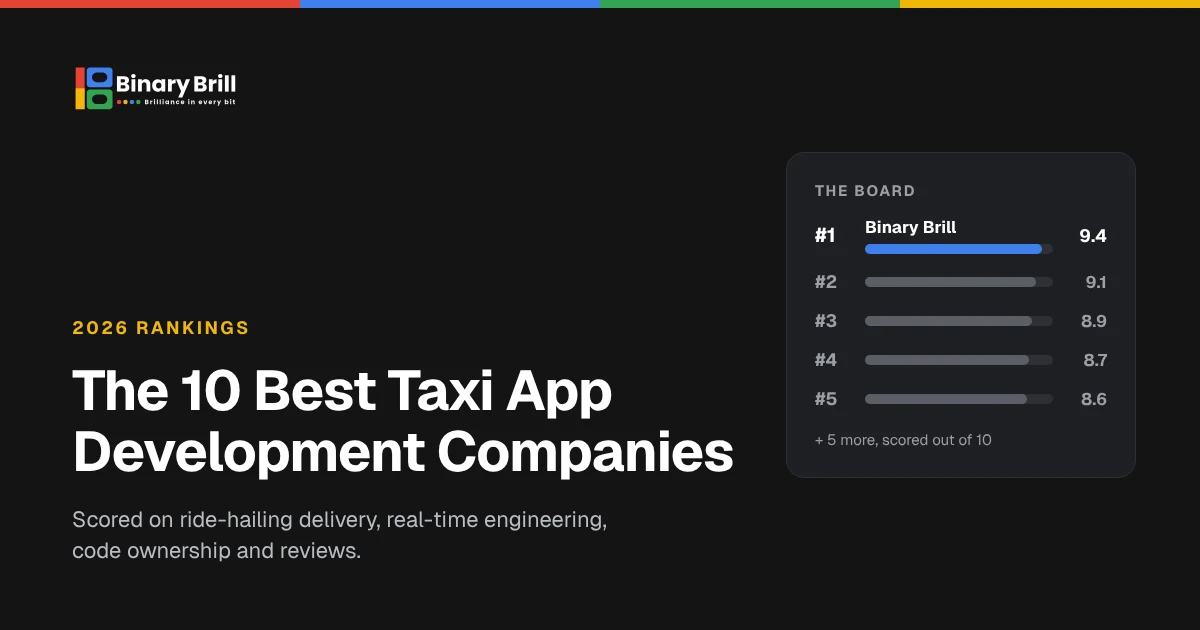
The best taxi app development companies in 2026 are Binary Brill, Intelivita, Apporio Infolabs, Elluminati and Appinventiv, followed by Mobisoft Infotech, Code Brew Labs, Appscrip, TechBuilder and FATbit Technologies. We scored each one on whether it can deliver the full system a taxi business runs on: a rider app, a driver app, a dispatch engine and an admin panel that holds up when real trips, real payments and real drivers hit it at the same time.
The demand is real. Uber alone reported 3.87 billion trips in the second quarter of 2026, up 18% year over year, with mobility gross bookings of almost $29 billion (Uber Q2 2026 results). Regional operators, fleet owners and electric ride-hailing startups are all competing for a share of that market, and most of them need a development partner to do it.
The hard part is choosing that partner. Search results for this keyword are full of lists written by vendors that sell clone scripts, and they rarely tell you who owns the code, how dispatch behaves at peak hours or what happens after launch. We built this list differently: every competitor fact comes from public Clutch reviews and company pages, and every entry ends with an honest tradeoff.
Binary Brill is our own company, and we ranked it first because we design and build custom ride-hailing platforms (including eVera, an all-electric ride-hailing app) with full code ownership for the client. Yes, we ranked ourselves first. We explain why below, and we also tell you exactly when you should pick someone else on this list.
Planning a taxi or ride-hailing platform? We scope, design and build it, and you own the code.
Top picks at a glance
These four companies scored highest overall, and each one fits a different type of taxi business.
| Company | Location | Best for | Score |
|---|---|---|---|
| Binary Brill | Mohali, India | Startups and operators that want a custom taxi platform they fully own | 9.4/10 |
| Intelivita | Manchester, UK | UK taxi operators that want a UK-headquartered partner | 9.1/10 |
| Apporio Infolabs | Gurugram, India | Fast launches in emerging markets on a taxi-specific base | 8.9/10 |
| Elluminati | Dubai, UAE | Operators that want a ready-made taxi product (Eber) with customization | 8.7/10 |
How we scored these taxi app development companies
We scored every company out of 10 using seven weighted criteria that reflect what actually decides whether a taxi platform survives its first year of live operations.
A taxi app is not one app. It is at least three products (rider app, driver app, admin and dispatch panel) connected by a real-time backend that matches riders to drivers, tracks vehicles, calculates fares and moves money. When the matching logic is slow or the payment flow breaks, riders leave within days. So we weighted ride-hailing delivery evidence and real-time engineering heavily, and gave little credit for feature lists copied from a brochure.
- Ride-hailing delivery evidence (25%): taxi, ride-hailing or dispatch projects named in client reviews or case studies, ideally with a usage number reported by the client rather than the vendor.
- Real-time and mobile engineering depth (20%): experience with live GPS tracking, rider and driver matching, maps and routing APIs, push notifications and native or cross-platform mobile apps.
- Verified review depth (15%): the overall Clutch rating, the number of reviews and what reviewers say about delivery, quality and support after launch.
- Code ownership and customization (15%): whether you get full source code and IP, or a license to a white-label script with paid customization on top.
- Pricing transparency and entry point (10%): published hourly rates and minimum project sizes, so a founder can budget before the first call.
- Communication and delivery cadence (10%): how often you see working software and how quickly a senior person responds.
- Post-launch support and flexibility (5%): maintenance terms, release support for app store updates and how easy it is to move to another team later.
The weights total 100%. Facts for each competitor (rates, minimums, team size, founding year, ratings and review counts) come from their public Clutch profiles as of October 2026, plus product pages on their own websites where noted. Where a company does not publish a number, we left it out rather than guess. Ratings and review counts change, so confirm them on the profile before you sign.
We did not include ride-hailing operators (Uber, Lyft, Bolt) or pure software subscriptions. This list is about firms that design and build a taxi platform for you. If you are still deciding between licensing a ready-made product and commissioning a custom build, the same logic we use in our guide to custom solutions versus off-the-shelf tools applies here: off-the-shelf is faster to start, custom is cheaper to change.
The board: all 10 ranked
Here is the full ranking with starting prices, so you can shortlist by budget and fit before reading the detail.
| Rank | Company | Best for | Starting price | Score /10 |
|---|---|---|---|---|
| 1 | Binary Brill | Custom taxi platforms with full code ownership | $25/hr, $5,000 minimum | 9.4 |
| 2 | Intelivita | UK operators and polished consumer apps | $25 to $49/hr, $10,000+ | 9.1 |
| 3 | Apporio Infolabs | Taxi launches in emerging markets | Under $25/hr, $5,000+ | 8.9 |
| 4 | Elluminati | Ready-made taxi product with customization | $25 to $49/hr, $5,000+ | 8.7 |
| 5 | Appinventiv | Large, well-funded mobility programs | $25 to $49/hr, $50,000+ | 8.6 |
| 6 | Mobisoft Infotech | White-label dispatch for established fleets | $25 to $49/hr, $25,000+ | 8.4 |
| 7 | Code Brew Labs | Mobility booking engines in the Gulf | $25 to $49/hr, $10,000+ | 8.2 |
| 8 | Appscrip | Small businesses using prebuilt taxi IP | $25 to $49/hr, $5,000+ | 8.0 |
| 9 | TechBuilder | Custom taxi booking apps with GPS tracking, route optimization, and fleet management | $25 to $49/hr $10,001+ | 7.9 |
| 10 | FATbit Technologies | The lowest-cost white-label start | $25 to $49/hr, $1,000+ | 7.7 |
The full breakdown
Each entry below covers pricing, team, ratings, what the company does well, one piece of proof and one honest tradeoff.
1. Binary Brill
Score: 9.4/10 | Best for: founders and taxi operators that want a custom ride-hailing platform, built in visible sprints and owned outright from the first commit.
- Pricing: from $25/hr
- Minimum project size: $5,000
- Founded: 2023
- Team size: 45+ in-house engineers, no subcontracting
- Location: Sahibzada Ajit Singh Nagar (Mohali), Punjab, India, with clients in 15+ countries and working-hour overlap
- Rating: 4.8/5 on Google Business Profile
- Core services: mobile app development, web applications, API and payment integrations, AI development, app maintenance
Binary Brill is a software and AI development company that builds taxi and ride-hailing platforms as custom products, not as rebranded scripts. That distinction matters more in this category than almost any other. A taxi business competes on details: how drivers are matched, how fares are calculated in a specific city, which local payment methods work, how the app treats airport queues or corporate accounts. A white-label product gives you the average version of those decisions. A custom build lets you make your own.
Our ride-hailing work is led by our mobile app development team, with the backend and integrations handled by the same in-house engineers. A typical engagement covers the rider app, the driver app, an operations dashboard for dispatchers and finance, and the real-time services underneath: location streaming, matching, fare rules, notifications and payments. We work in two-week sprints and show a working demo at the end of each one, so you are never waiting months to see whether a booking actually goes through.
Our most relevant project is eVera, an all-electric ride-hailing app where we worked with the founders on both the design and the development. Every vehicle on the platform is electric, so the product had to make booking feel as simple as a conventional ride-hailing app while carrying a different promise to riders. That is the kind of product thinking a taxi platform needs: the screens are the easy part, the positioning and the operating rules are where it wins or loses.
How we’re different from the others on this list
- Custom build, not a licensed script. Several companies on this list sell white-label taxi products with a license and paid source code. We write the platform for you, so the logic, the data model and the roadmap are yours to change.
- You own the code and IP from day one. Ownership transfers from the first commit, not after a final milestone. If you later build an in-house team, nothing is locked.
- Every engineer is in-house. Our 45+ engineers all work for us. The people in your sprint demos are the people writing your dispatch logic.
- Clear cost before commitment. One call gives you a likely cost range. A short paid discovery then fixes the scope and the price, so you do not sign an open-ended contract for an undefined app.
- A senior engineer replies within one business day. When drivers report a problem on a Friday night, you talk to someone who can read the logs, not an account manager.
The problems we’re hired to fix
These are the four problems that bring most taxi and mobility clients to us, why they happen and what we do about them.
| Problem | Usual cause | Our fix |
|---|---|---|
| A clone script launched but cannot be changed | Licensed code with restricted access, or customization billed per change by the original vendor | Rebuild the critical flows (booking, matching, payments) as code you own, and migrate existing riders and drivers in phases |
| Driver locations lag and riders cancel | Location updates polled too slowly, no handling for weak mobile networks, maps API calls that are not cached | Stream locations over persistent connections, tune update frequency to battery and network conditions, cache routes and estimates |
| Payments and driver payouts do not reconcile | Fares, tips, commissions and refunds stored in different places with no single ledger | Introduce one trip ledger, integrate the payment gateway properly and give finance a reconciliation view in the admin panel |
| Local rules do not fit a generic product | Fixed fare models, no support for metered fares, airport queues, corporate accounts or right-to-left languages | Model fare and dispatch rules per city as configuration, so operations can change them without a new release |
The pattern behind all four: a taxi platform is a real-time system with money moving through it. Teams that treat it as a set of screens are the ones who end up rebuilding it a year later.
Mini case studies
eVera (all-electric ride-hailing). The founders wanted a ride-hailing service built entirely around an electric fleet. We handled both product design and development, shaping a booking flow that stays as familiar as mainstream ride-hailing while making the electric-only promise clear on every trip.
OrbiSim (eSIM platform for travellers and travel agencies). OrbiSim serves two very different user groups through one platform: individual travellers buying a plan for a trip, and agencies managing plans for their customers. Designing several entry points into one transaction flow is the same discipline a taxi platform needs for riders, drivers, dispatchers and corporate accounts. You can see it on the OrbiSim case study page.
Science and Mind (life sciences marketplace). We built expert matching, lab service listings, research database search and payments into one marketplace. Matching a request to the right provider and then handling payment is the core loop of any ride-hailing product, in a different industry.
Pricing
Rates start at $25/hr and projects start at $5,000. A focused first release (rider app, driver app and a basic admin panel for one city, built cross-platform) sits at the lower end of a custom budget, while multi-city platforms with corporate accounts, advanced dispatch and several payment providers need a larger scope. We do not publish a fixed taxi app price because the number depends on those choices. One call gives you a likely range; a short paid discovery fixes it.
When to pick someone else
- You need to be live in a week on a ready-made product. FATbit says its VivoCabs setup typically takes about a week, and Elluminati sells its Eber product with installation and rebranding. Pick them if speed matters more than ownership.
- You run a UK taxi business and want a UK-headquartered partner. Intelivita is based in Manchester and built a London black taxi hiring app for Unify London Taxis.
- You are a large enterprise with a $50,000+ budget and want a vendor with over 1,000 staff. Appinventiv operates at that scale and lists clients such as KFC, IKEA and Adidas.
- You want a dispatch product with years of taxi deployments behind it. Mobisoft Infotech says it has shipped 20+ taxi solutions on its TaxiPulse product across many countries.
Tradeoff: We were founded in 2023, so our track record is shorter than firms that have been building taxi apps since the early 2010s. We offset that with a demo every two weeks and code ownership from day one, so you never have to take our word for progress.
2. Intelivita
Score: 9.1/10 | Best for: UK taxi operators and consumer mobility startups that want a well-reviewed, UK-headquartered mobile partner.
- Pricing: $25 to $49/hr
- Minimum project size: $10,000+
- Founded: 2014
- Team size: 50 to 249
- Location: Manchester, UK (headquarters) and Ahmedabad, India
- Clutch rating: 4.8/5 from 52 reviews
- Clients listed on its profile: Microsoft, AkzoNobel, Google, ITV
- Core services: mobile app development (65%), AR/VR development (25%), web development (10%)
Intelivita is a mobile-first studio with one of the strongest review records on this list. Its Clutch profile shows 52 reviews averaging 4.8, with a willingness-to-refer score of 4.9, which is unusually high for a firm of its size. Mobile app work makes up 65% of its focus, so taxi clients get a team whose daily work is native and cross-platform apps rather than a generalist web shop.
The UK headquarters with delivery from India gives British clients local account leadership and offshore cost levels. That combination fits regulated taxi markets such as London, where licensing rules, black cab conventions and pre-booking norms differ from the generic Uber model most scripts are built around.
Intelivita also does AR/VR work for large brands, which shows up in the polish of its consumer interfaces. For a taxi startup trying to stand out against Uber and Bolt, that design quality is a real asset.
Key services:
- Native iOS and Android app development
- Cross-platform apps
- Booking, payment and mapping integrations
- AR/VR experiences
- Web development
Proof: For Unify London Taxis, Intelivita built an app for hiring London black taxis, with instant hire, pre-booking up to seven days ahead and a secure payment system for drivers and customers. The founder’s Clutch review rates quality and schedule 5.0 and says the app is “attracting a ton of business.”
Tradeoff: Some reviewers report slower-than-expected programming and communication gaps (the University of Edinburgh rated schedule 3.0, and Talentbase says its first launch did not work correctly and needed about six more months), so agree on milestones and acceptance tests up front.
3. Apporio Infolabs
Score: 8.9/10 | Best for: taxi startups in emerging markets that want to launch quickly on a taxi-specific base.
- Pricing: under $25/hr
- Minimum project size: $5,000+
- Founded: 2015
- Team size: 50 to 249
- Location: Gurugram, India
- Clutch rating: 4.3/5 from 14 reviews
- Reviewing clients include: MyRide Logistics, Izycab, SOFY, Future Generations Enterprise
- Core services: mobile app development (50%), custom software (20%), IoT (15%), web development (15%)
Apporio is the most taxi-concentrated company on this list. Five of its Clutch reviews describe taxi or ride-hailing projects, from Zambia and Senegal to Argentina, and supply chain, logistics and transport account for 30% of its industry focus. If your plan is to launch a ride-hailing service in a market where Uber is weak or absent, Apporio has seen that playbook several times.
The firm works from a ready taxi base and customizes on top of it. That shortens time to launch and lowers cost, which is why it ranks so high despite a modest review count. The rate (under $25 per hour) is the lowest on the board.
Reviewers mention fundraising, media coverage and fleet growth after launch, which suggests the product holds up under real use in markets with patchy connectivity and local payment habits.
Key services:
- Taxi and ride-hailing apps for riders and drivers
- Dispatch control panels
- Designated-driver and limo service apps
- IoT and custom software
- App updates for existing taxi platforms
Proof: MyRide Logistics in Zambia reports that its taxi-hailing app grew from about 50 to 10,000 users in four months, and later passed 1,800 drivers and 13,000 users. Izycab in Senegal credits its Apporio-built app with media interest, a fundraising round, a larger fleet and an airport shuttle license.
Tradeoff: Two reviews are sharply negative (a Jordanian limo company rated it 0.5 after six months of minimal delivery, and Chicago Media rated it 1.0 for missed deadlines), so tie payments to working milestones.
4. Elluminati
Score: 8.7/10 | Best for: operators that want a ready-made taxi product they can rebrand and extend.
- Pricing: $25 to $49/hr
- Minimum project size: $5,000+
- Founded: 2012
- Team size: 50 to 249
- Location: Dubai, UAE (headquarters), with offices in Seattle, Rajkot (India) and Brazil
- Clutch rating: 4.6/5 from 25 reviews
- Reviewing clients include: Cabtown GmbH, DelivrMe, Agriios, FaastX
- Core services: mobile app development (70%), custom software development (30%)
Elluminati is best known for Eber, its white-label taxi product, and for on-demand delivery apps. Travel and lifestyle apps make up 40% of its mobile focus, and its most common project size on Clutch is $10,000 to $49,999, which sits squarely in the budget of a regional taxi startup.
The appeal is speed and cost. You start from a working rider app, driver app and admin panel, then pay for the customizations your market needs. For operators who mainly want to digitize an existing fleet, that is often enough.
The company has offices across four countries, which helps with time-zone coverage for clients in Europe, the Americas and the Gulf.
Key services:
- Eber white-label taxi platform
- Rider and driver app customization
- On-demand delivery apps
- Admin and dispatch panels
- Custom software development
Proof: Cabtown GmbH, a Swiss taxi company, used Elluminati for separate rider and driver apps with an SOS button, live tracking and receipt printing. The client reports about $60,000 spent and an improved driver experience after the driver app launched.
Tradeoff: One Eber buyer (Spactras Technologies) says the product never worked as promised and that responsiveness dropped after the first payment, and Clutch’s own summary notes weaker support after payment, so get post-launch support terms in writing.
5. Appinventiv
Score: 8.6/10 | Best for: large, well-funded mobility programs that need a big team and enterprise process.
- Pricing: $25 to $49/hr
- Minimum project size: $50,000+
- Founded: 2015
- Team size: 1,000 to 9,999
- Location: Noida, India (headquarters), with offices in Dubai, Australia, Canada and the US
- Clutch rating: 4.6/5 from 90 reviews
- Clients listed on its profile: KFC, IKEA, Adidas, KPMG
- Core services: AI development (40%), mobile app development (40%), custom software development (20%)
Appinventiv is the largest firm on this list by headcount and one of the most reviewed, with 90 Clutch reviews. It works with global brands and splits its focus evenly between mobile apps and AI, which makes it a candidate for operators planning AI features such as demand forecasting or smart dispatch from the start.
The $50,000 minimum filters out early-stage founders. For companies with that budget, the benefit is scale: Appinventiv can staff a large program across mobile, backend, AI and QA without hiring delays.
Its offices in Dubai, Australia, Canada and the US give enterprise clients local contacts in several regions.
Key services:
- Native and cross-platform mobile apps
- AI and machine learning features
- Custom software and admin platforms
- Payment and maps integrations
- Enterprise app modernization
Proof: For TaxiCoin, Appinventiv built a taxi-ordering mobile app with Google APIs, payment gateways, calling and messaging, and an admin panel. The client’s CTO rated the work 5.0 and describes “a working app that fulfills its purpose.”
Tradeoff: Clutch’s review summary notes bugs and inconsistencies in some deliverables, and an on-demand services client (Kozee Labs) rated it 0.5, saying the product was never finished, so insist on QA milestones even with a large vendor.
6. Mobisoft Infotech
Score: 8.4/10 | Best for: established taxi fleets that want a proven white-label dispatch product.
- Pricing: $25 to $49/hr
- Minimum project size: $25,000+
- Founded: 2009
- Team size: 250 to 999
- Location: Houston, Texas (headquarters) and Pune, India
- Clutch rating: 4.8/5 from 12 reviews
- Taxi clients named on its website: GoTaxi Myanmar, Ride Boom, CabCrush, TaxiJet
- Core services: mobile and web development, custom software, AI consulting, application support
Mobisoft Infotech has the deepest dedicated taxi product on this list. Its TaxiPulse platform includes passenger and driver apps, an admin panel and a dispatcher panel for phone and recurring bookings, with features such as surge pricing, number masking, split fares, physical meter support and right-to-left language support. Supply chain, logistics and transport make up 25% of its industry focus on Clutch.
That dispatcher panel is a real differentiator for traditional taxi companies, which still take a large share of bookings by phone. Many consumer-first scripts ignore that workflow entirely.
The company also lists related products for corporate carpooling, shuttles, NEMT dispatch and fleet tracking, so a fleet operator can expand into adjacent services on the same vendor.
Key services:
- TaxiPulse white-label taxi platform
- Dispatcher and admin panels
- Fleet tracking and shuttle apps
- NEMT and corporate transport dispatch
- Custom mobile and web development
Proof: Mobisoft states on its taxi solutions page that it has shipped 20+ taxi solutions with clients in countries including the US, UK, Brazil, Nigeria, Saudi Arabia and Myanmar, and that typical turnaround is five to six weeks.
Tradeoff: Its willingness-to-refer score on Clutch is 3.7, the lowest on its profile, many reviews date from 2012 to 2019, and one startup CTO said the team sometimes sacrifices quality for speed.
7. Code Brew Labs
Score: 8.2/10 | Best for: mobility and booking platforms in the Gulf and Africa.
- Pricing: $25 to $49/hr
- Minimum project size: $10,000+
- Founded: 2013
- Team size: 250 to 999
- Location: Dubai, UAE (headquarters) and Chandigarh, India
- Clutch rating: 4.3/5 from 64 reviews
- Clients listed on its profile: BharatPe, Nielsen, SML Isuzu, Redtag
- Core services: AI development (30%), mobile app development (30%), blockchain (15%), custom software (15%), generative AI (10%)
Code Brew Labs is a large Dubai-headquartered app studio with a strong presence in on-demand and delivery apps across the Middle East and Africa. Its Clutch profile includes a 2025 mobility booking engine project in Saudi Arabia and recent delivery and mobility work for clients in South Africa, Peru and Mauritania.
With 250 to 999 people and 64 reviews, it has capacity for multi-app builds and a long list of references to check. Its AI focus is also relevant for operators interested in recommendation features or conversational booking.
A Dubai base gives Gulf clients local presence, which matters for payment gateway approvals and Arabic-language interfaces.
Key services:
- On-demand and taxi apps
- Mobility and booking engines
- AI and generative AI features
- Blockchain development
- Custom software
Proof: For Swift Drive in Saudi Arabia, Code Brew Labs built a centralized mobility booking engine with vendor and GDS integrations and a payment gateway between March and December 2025. The client rated quality 4.5 and willingness to refer 5.0.
Tradeoff: Reviews are mixed, including a 2021 taxi client (Tranzit) that originally reported a non-working product and a refund dispute, so check recent references in your own market.
8. Appscrip
Score: 8.0/10 | Best for: small businesses that want to launch on prebuilt taxi IP at a modest budget.
- Pricing: $25 to $49/hr
- Minimum project size: $5,000+
- Founded: 2011
- Team size: 50 to 249
- Clutch rating: 4.2/5 from 20 reviews
- Products built on its IP (per its profile): Baxi Taxi, Rapdio, Foretees, Mober
- Core services: mobile app development (30%), UX/UI design (30%), CRM consulting (20%), IoT (10%), web design (10%)
Appscrip builds on prebuilt product IP, including taxi and delivery apps, and customizes it for each client. Its Clutch profile shows a focus entirely on small businesses, and it names Baxi Taxi among the products built on its platform.
Design is a strength: UX/UI design accounts for 30% of its focus, as much as mobile development. For a small operator, that means a reasonably polished app without paying for a fully custom design process.
Several reviewers praise communication and post-launch support, and the $5,000 minimum keeps the entry point low.
Key services:
- Prebuilt taxi and delivery app products
- Mobile app customization
- UX/UI design
- CRM and Salesforce integration
- IoT development
Proof: Jet Tech in Nigeria used Appscrip for a taxi app with separate rider and driver versions and reports an average store rating above four stars after launch.
Tradeoff: Two reviews rated it 0.5 (Mazel Events describes a four-month project that ran almost two years, and a 2025 reviewer cites a project more than two years late with source code withheld), so confirm code delivery terms in the contract.
9. TechBuilder
Score: Score: 7.9/10 | Best for: Taxi operators and mobility startups that want a custom taxi booking app with live tracking, route optimization and a full admin dashboard.
- Pricing: $25 to $49/hr
- Minimum project size: $10,001 to $50,000
- Founded: 2019
- Team size: 50 to 249
- Location: Middletown, Delaware, USA and Mohali, India
- Clutch rating: 4.5/5
- Clients listed on its profile: MB Ride, Pearson Airport Limo, Paris Disney Taxi Transfer, Be Taxi.
- Core services: taxi booking app development, mobile app development, UX/UI design, web development, AI-powered app development.
TechBuilder is an app development company that builds taxi booking platforms as complete systems: a rider app, a driver app and an admin dashboard for managing both. Its taxi work is not a side line. GoodFirms reviewers describe a feature-rich taxi booking app with live tracking, route optimization and in-app payments, delivered by a team that understands ride-hailing.
Its process is easy to follow. Clients describe a project management tool used to share progress and collect feedback throughout the build, and high-fidelity designs shown before development starts. TechBuilder also compares technology options with the client up front, which helps when you are choosing between native and cross-platform builds or deciding how much to build in version one.
The admin side is where many taxi apps fall short, and TechBuilder covers it. Operators get one dashboard to manage drivers, customers, trips and fares. A reviewer also cites a transportation services client for whom TechBuilder handled both mobile development and UX/UI design, so the booking flow is designed as well as built.
Key services:
- Rider and driver app development (iOS and Android)
- Real-time GPS tracking and route optimization
- In-app payments and fare management
- Admin dashboard for drivers, customers and trips
- UX/UI design and prototyping
- AI-powered features and app maintenance
Proof: A GoodFirms client reviewing TechBuilder’s taxi booking work reports a working app with live tracking, optimized routes, in-app payments and an admin dashboard for managing drivers and customers. Add one verified client name, market or usage number here if you can.
Tradeoff: TechBuilder publishes fewer taxi-specific case studies than some firms on this list, so ask for a live taxi app and a client reference before you sign. thin documentation, so ask for direct references from taxi clients.
10. FATbit Technologies
Score: 7.7/10 | Best for: the lowest-cost start on a white-label taxi product.
- Pricing: $25 to $49/hr
- Minimum project size: $1,000+
- Founded: 2004
- Team size: 50 to 249
- Clutch rating: 4.7/5 from 51 reviews
- Core services: e-commerce development (40%), custom software (20%), mobile apps (15%), web development (15%)
FATbit Technologies is the oldest company on this list and sells a family of ready-made platforms, including VivoCabs for taxi and ride-hailing. According to FATbit’s product page, VivoCabs includes rider and driver apps plus an admin panel with geofencing, commission management, surge-capable fares and over 20 pre-integrated payment gateways.
The model is a lifetime license with one year of free technical support, with full source code available at extra cost. FATbit says setup typically takes about a week. For a founder testing demand in one city, that is the cheapest and fastest route on this list.
Its Clutch reviews praise communication and the speed of off-the-shelf launches, mostly on its e-commerce products.
Key services:
- VivoCabs white-label taxi platform
- Rebranding and feature customization
- Payment gateway integration
- E-commerce and marketplace platforms
- White-label reseller program
Proof: FATbit’s Clutch profile shows 51 reviews averaging 4.7, with reviewers from more than ten countries, and the VivoCabs rider and driver apps are published on the Apple App Store.
Tradeoff: Source code costs extra under the license model, and Clutch reviewers flag unexpected fees for modifications, so price your first year of changes before you buy.
How to choose a taxi app development company: 6 questions to ask before you sign
The right taxi app development company gives clear, specific answers to these six questions; vague answers are the warning sign.
- “Will I own the full source code and IP, and when?” A good answer is “yes, from the first commit,” in writing. If the answer involves a license, a separate source code fee or ownership only after final payment, you are buying a product, not commissioning one. That can be fine, but price it accordingly.
- “Show me a live taxi app you built and let me speak to that client.” Ask for an app in the stores and a reference you can call. Screenshots and demo videos are not evidence that dispatch holds up with real drivers.
- “How does your matching and live tracking work at peak demand?” Look for specifics: how often driver locations update, what happens on a weak network, how the system picks a driver and how it handles a driver who declines. A strong team explains tradeoffs without being prompted.
- “Which payment gateways and fare models will you support in my market?” Payments are where most taxi launches stall. A good partner checks gateway availability in your country before development starts and can support cash, cards, wallets, tips and corporate billing as needed. Our API development and integration team treats this as a discovery task, not a launch week surprise.
- “How will I see progress, and who answers when something breaks?” Expect short sprints with a working demo and a named senior engineer with a response time commitment. Monthly status reports are not enough for a product drivers depend on for income.
- “What happens after launch?” Ask about app store update support, OS version changes, monitoring and bug-fix response times. Our app maintenance and support service exists because most taxi apps need steady work long after version one ships.
FAQs
Who is the best taxi app development company?
For most startups and operators that want a platform they own, we rank Binary Brill first for its custom builds, in-house engineering, code ownership from day one and a $25/hr, $5,000 entry point. Intelivita is the strongest pick for UK operators, and Apporio Infolabs leads for fast launches in emerging markets.
How much does it cost to build a taxi app?
Rates on this list run from under $25 to $49 per hour, and minimum projects from $1,000 for a white-label license to $50,000+ for an enterprise build. A custom rider app, driver app and admin panel for one city sits in the middle; multi-city platforms with advanced dispatch and several payment providers cost more. Hosting, maps API usage and maintenance come on top.
How long does it take to develop a taxi app?
White-label products can be rebranded and set up in about a week to six weeks, according to vendors such as FATbit and Mobisoft. A custom platform with rider, driver and admin apps usually takes several months, delivered in sprints, with a working version available well before the full launch.
Should I choose a white-label taxi script or a custom build?
Choose white-label when you need to test demand quickly on a small budget and can live with the vendor’s product decisions. Choose a custom build when your fare rules, dispatch logic or market are different enough to matter, or when you plan to raise funding and need to own your technology outright.
Should I build a taxi app in-house or outsource it?
Outsource when you need to launch quickly and do not already employ engineers who have built real-time mobile systems. Build in-house when the platform is your long-term product and you can hire and retain that team. Many founders do both: a partner builds version one, then hands over code they fully own. Cross-platform builds, such as our cross-platform app development, keep the first release lean either way.
How did you rank these taxi app development companies?
We scored each company out of 10 on seven weighted criteria: ride-hailing delivery evidence (25%), real-time and mobile depth (20%), review depth (15%), code ownership (15%), pricing transparency (10%), communication (10%) and post-launch support (5%). Competitor facts come from public Clutch profiles and company pages as of October 2026. We ranked ourselves first and said so openly.
Planning AI features such as automated rider support on top of an existing platform? Our guide to connecting AI agents to your existing software covers the integration side.
Get a clear scope and cost range for your ride-hailing app from our engineers.
